

A new study has identified the key areas where farmers can get the best out of their calves during the crucial first few months of life.
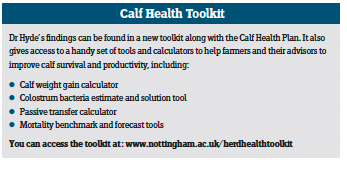
Information on the current approaches to calf rearing was captured and analysed from 60 dairy farms across GB by Dr Robert Hyde who undertook the work as part of his AHDB funded PhD at the University of Nottingham’s Vet School. Data such as daily live weight gain, calf mortality and incidence of disease were taken from each farm. Sophisticated machine learning techniques were then applied to identify the common practices that influenced calf survival, health and growth.
Dr Hyde incorporated these success factors into a Calf Health Plan before trialling it with the 60 farms involved in the initial study. Half followed the new plan, while the remainder were given no specific advice on how to improve and continued to monitor their calf KPIs.
After a six-month monitoring period, Dr Hyde found that “the calves on the farms which completed the most intervention in the Calf Health Plan achieved higher average daily gains, improved survival and less scour than calves on the control farms.”
Colostrum hygiene is key
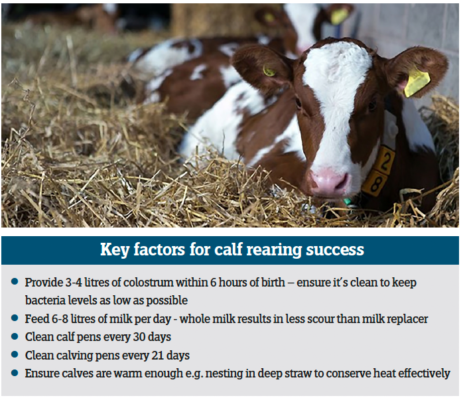
The study highlights the importance of good hygiene during colostrum collection. Calves failing to get good immune transfer from colostrum are 1.5 times more likely to get scour, 1.8 times more likely to get pneumonia and twice as likely to die.
Colostrum can easily be contaminated with bacteria and do calves more harm than good. Using scalding hot water when washing equipment, instead of cold water, had a drastic impact on keeping bacterial levels low.
Bacteria levels were lowest on the 15% of farms using Hypochlorite or Peracetic acid as part of their cleaning routine. Pasteurisation can be a very effective way to keep bacterial levels low without affecting quality but not a very popular option with only 3% of farm doing so.
More information about how to optimise calf performance, rear healthy calves and keep mortality to a minimum can be found in AHDB’s calf management guide.
Temperature
To understand the impact temperature has on calf survival, Dr Hyde undertook an extensive analysis of the British Cattle Movement Database and Met Office temperature data from 2010 to 2019.
The effect of temperature and month of birth play an important role in calf survival with the number of calves dying spiking during winter months. And when the temperature falls below 9.6°C, the risk of dairy-beef calves dying is greater.
Dr Hyde said, “If calf housing was able to replicate optimal environmental conditions for young calves all year round, there would be more calves surviving.”
Low environmental temperatures are associated with higher calf deaths and reduced growth rates. Since pre-weaned calves are susceptible to heat loss, Dr Hyde also designed a study to evaluate the impact of calf jackets and supplementary heat source.
He used a 1kW patio heater and evaluated its impact on growth rates. The randomised clinical control trial showed that jackets had no effect but the heat lamp added an extra 90g per day in weight gain over winter.