
Long hot summer days can mean bad news for calves, in particular, bringing disease, discomfort and a growth slump at weaning. British Dairying looks at what producers can do to mitigate the negative effects of unexpectedly high temperatures.
Studies have been carried out to understand the impact of rising world temperatures on farmed cattle, but with temperatures continuing to climb, this is not something to be complacent about.
The performance, health and wellbeing and, ultimately, financial impact can be significant, warns Dr Christine Cummins at Bonanza Calf Nutrition.
Heat stress
Heat stress occurs in dairy cows when they absorb more heat than they can expel, leading to discomfort, reduced feed intake, poorer productivity and impaired fertility. Calves, especially
those in hutches or south facing sheds, may suffer from heat stress.
This can mean reduced appetites, especially for dry feed, greater respiration rates and higher rectal temperatures. A scenario leading to poorer growth rates. “Humidity, something that can climb
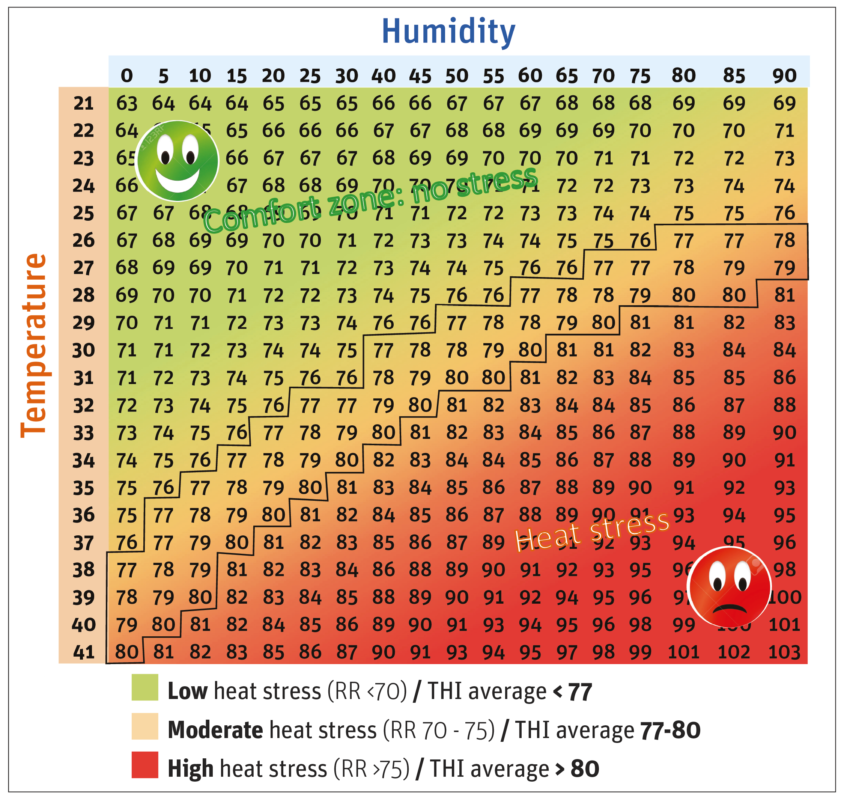
quite high in the UK, coupled with high temperatures really is your enemy,” says Christine. “Combined, they are referred to as the Thermal Humidity Index (THI).
Why is this important? “One important reason is that calves alter their behaviour as they are impacted by a high THI and can become dehydrated,” she explains. “If they are then exposed
to scour or pneumonia-causing bugs, they may succumb very quickly because their immune system is weakened while their body focuses on trying to control body temperature.”
Calves attempt to maintain a constant body temperature, regardless of the ambient temperature, and within a certain temperature range – the thermoneutral zone, approximately 0˚C – 23°C in a one-month-old calf. Often, they can accomplish this without expending extra energy. “But the thermoneutral zone is not constant and it is affected by many things out of a farmer’s control, including the effective ambient temperature the calf experiences. This is influenced by air movement, moisture, hair coat, sunlight, bedding, and rumination,”
Christine explains. “June to early September is the main risk period, and work in the US has found that hutches can be 2⁰C warmer than the ambient temperature, especially on calm days in exposed sites.”
Recent work undertaken in Italy and Spain has established the THI threshold in pre-weaned calves in Europe. “As indicated in the graphics, in the zone exceeding 77, calves will become uncomfortable, while in a THI exceeding 80, calves can no longer regulate their body temperature; they will have a raised respiratory rate and will be extremely uncomfortable,” says Christine. “The US work seems to indicate that calves experience less stress when the temperature drops overnight – they can effectively re-set.
Continuously high day and night temperatures, as seen last summer, is when serious problems can start. “This is because of the build-up of heat within the calf. As hard feed intake
reduces, rumen development slows, which is something that will affect the calf for weeks and months into the future, and it will lead to a growth slump at weaning.”
Trials in Italy in conjunction with the University of Milan, over two years, showed Bonanza’s heat stress additive reduced respiration rates by seven to eight breaths per minute, and rectal temperatures on average by 0.5⁰C where calves were in high THI conditions.
Improved weight gain
Weight gain improved by as much as 30% during this period and calf health treatments fell by a third, when calves were fed Shine Heiferstart alongside the heat stress additive. “The new additive allows calves to better combat thermal stress, which is better for animal health, welfare and comfort,” explains Christine. “By improving respiratory rate and significantly reducing rectal temperature, the calf will be much happier. This leads to better growth, improved feed efficiency and an overall better health status.”
Strategies to beat the heat
- Provide shade: An 80% shade cloth positioned above hutches can reduce hutch temperatures by 16%. In sheds, providing shade against direct sunlight can also be helpful.
- Move the air: Make the most of prevailing winds and ensure vents are open. In sheds, running a fan between 8am – 5pm was shown to improve average daily gains by 23% and feed efficiency by 20%, when compared with calves housed in a shed without a fan.
- Offer plenty of water: As calves attempt to maintain their body temperature, water is lost through increased respiration and evaporative cooling (sweating). There is evidence to show that regular, daily cleaning of water buckets helps ensure water intakes remain at a good level.
- Consider nutrition: Discuss with your nutritionist and / or feed adviser how to feed and supplement the calves’ diet to support them during high temperatures. This is especially important for calves born from heat stressed dams; calves often have lower birthweights and receive lesser quality colostrum from the dam, and are at greater risk.