
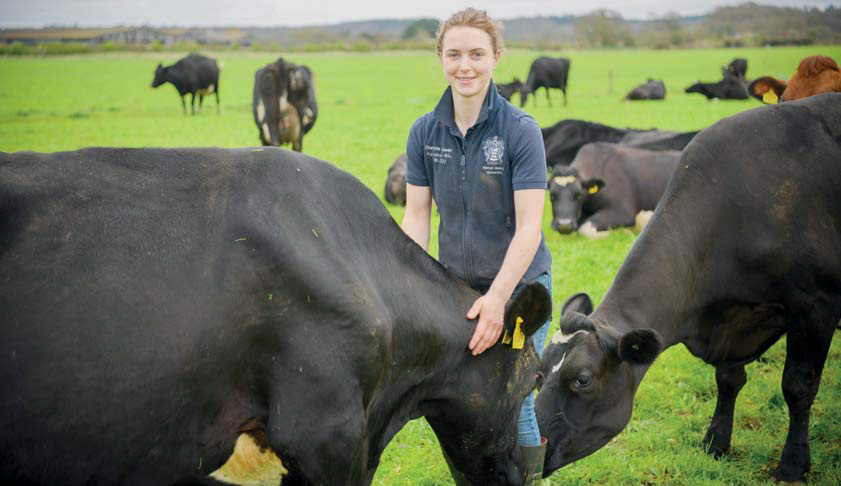
The autumn cycle of inseminating cows, grazing youngstock and drying off the spring calvers is starting to wind down at Bisterne Farms. That’s allowed the team to celebrate recent awards and look forward to Christmas, as Charlotte Lawder explains.
It’s been a busy few weeks here on the farm, and, as the year wraps up, we’ve been balancing everything, from breeding to drying off cows, to finishing up some personal learning milestones.
The R1s (heifers up to a year old) are still housed, fully weaned off milk, and settling well on a diet of cake and silage. They’re getting 3.5kg/head per day, and since introducing silage recently, they’ve been thriving. At three and a half months old, they’re growing well.
Our spring calves and R2s (heifers up to two years old) are now out on the fodder beet. The R2s had fixed-time artificial insemination (AI) earlier, spent three weeks grazing with the bulls, and have now transitioned to beet grazing for winter. It’s a low-input system, but they seem content. They’ll get new silage bales daily, and we’ll move the break fence daily to ensure they are on fresh ground.
Synchronising heifers
Speaking of AI, fixed-time AI (or heifer sync) continues to be a good strategy for us. It costs about £28/heifer, including vet and drug costs, and ensures all the dairy calves from heifers are born around the same time. Any that don’t take with AI will be caught by our six Hereford bulls.
It’s a big day when we do the AI, but batching them makes it manageable and efficient.
At the end of November, we moved our spring herd to once-a-day milking. In early December we’ll start drying off 60 of the earliest calvers, and by Christmas, we’ll have the entire spring herd dry.
Thanks to the mild November weather, they’re still out grazing, which has been a huge help. We even managed to get down our grass tracks without them turning into a soggy mess, something that’s usually a challenge this time of year.
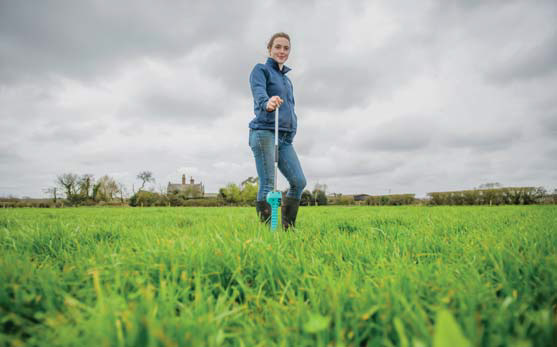
Grass growth, however, has been slower compared to last October, down to 10kg/ha of dry matter per day from 58.4kg last year. A big drop. The wet and cold October likely played a role, but November’s warmer weather has helped maintain some growth. We’re planning to finish grazing by December 20. The autumn herd is fully housed now, on a diet of cake and silage. One challenge we’ve faced is avalanches in the clamp, likely due to stormy weather and maybe pushing the feed wires too close to the face. It’s been manageable with the scraper tractor, but something we’re keeping an eye on.
Two weeks into breeding the autumn group we are pleased with a 65% submission rate so far. We’ve been using a mix of dairy and beef semen, including some new Charolais genetics alongside our usual New Zealand Friesian, Holstein, Hereford, and Angus.
We’ll also introduce short-gestation Blue semen in weeks five and six, followed by the Angus to avoid mix-ups at calving.
Monitoring bulling involves a mix of paint and stickers. Cutting the stickers in half lengthways saves us money without sacrificing effectiveness; they’re about 53p each, so the savings add up! We also bring in an AI technician to help with accuracy and save time, especially at the start when we’re doing up to 16 cows/day.
On a personal note, I recently finished the Entrepreneurs in Dairying course, and it’s been an incredible experience. The course, designed for people looking to grow their dairying knowledge and start their own businesses, ran over seven sessions since September.
The finance module was the most useful, and a visit to see a former delegate who’s now thriving with a contract farming agreement was the most inspirational.
Being part of a group of like-minded, hard-working people from a range of farming backgrounds was a highlight.
Ending on a positive note
We recently attended the Avon and Stour Agricultural Society Awards evening, which was a great chance to get off the farm, socialise, and celebrate successes.
We even won three awards around our management of youngstock and cows, which was a fantastic feeling and a nice recognition of our efforts.
In the coming weeks, we’ll finish breeding the autumn cows, dry off the spring herd, and move them onto beet.
On the social side, we’ve got our Christmas do planned – Secret Santa, go-karting, and a meal. It’s a nice way to wind down and reflect on the year with the team and their partners.
Farming is always busy, but finding time to plan, reflect, and celebrate is just as important as getting the daily tasks done. Here’s to wrapping up the year on a positive note!