
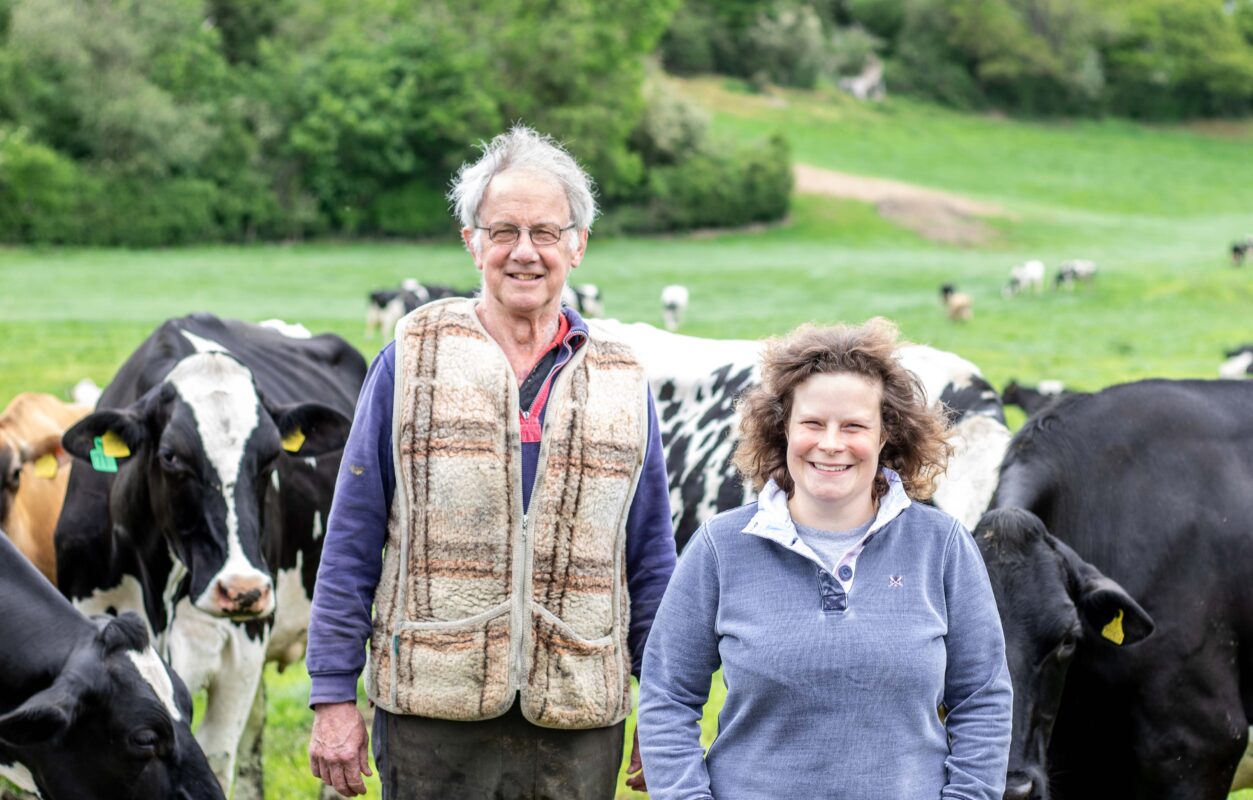
Philip Davies offered Hannah Edwards an opportunity to take over the farm as he stepped back
From gap year to herd owner: How one young farmer from Shropshire has built a business through a bespoke farming agreement. Rhian Price reports.
When Hannah Edwards took a gap-year job on a Powys dairy farm before university, she never imagined it would change the course of her life. Having grown up on a dairy farm near Shrewsbury, she secured a place to study biochemistry at Cardiff University. But after working at Hill Farm, Crew Green, she realised her real passion lay in dairying.
Hannah worked on the farm for more than a decade between travelling. Then, four years ago, farm owner Philip Davies wanted to take a step back and decided to disperse his 180-cow pedigree Holstein herd. But he wasn’t ready to retire entirely. With his son working in catering and his grandson pursuing a career in economics, he asked Hannah if she would like to take over the farm. “He said, ‘How do you feel about having a go?’ and I didn’t want to regret not trying,” recalls Hannah.
Trusted hands
Philip had previously gifted Hannah a calf from her favourite cow in his pedigree Crew Hill herd, sparking her interest in pedigree cattle. By the time of the dispersal sale, she had already amassed a small nucleus herd of 16 milkers and 16 youngstock.
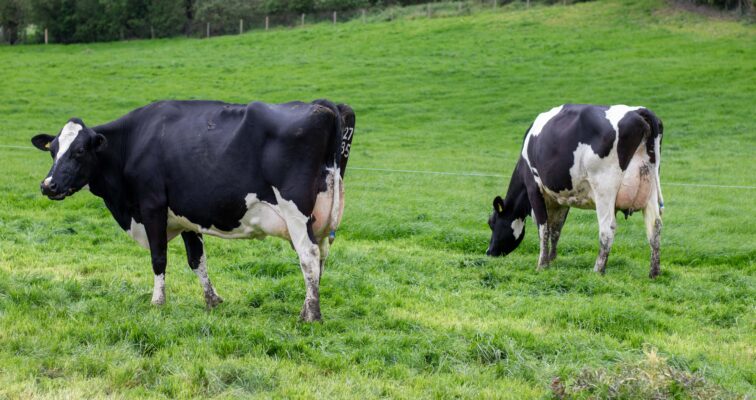
For Hannah, it seemed like an opportune moment to take the reins. She secured a £50,000 business loan from HSBC against her cattle and bought additional cows at Philip’s sale. She officially began selling milk in her own name in October 2022, with 46 milkers and 15 youngstock. Since then, the herd has grown to 80 milkers plus 88 followers. The agreement has evolved over time. Initially, nothing was written down, although the pair sought advice from a local land agent. “We had known each other for a long time, and there was a lot of trust on both sides,” explains 36-year-old Hannah. More recently, the agreement has been formalised through a written contract.
Hannah, who also works part-time at a neighbouring beef and arable farm, rents the farm and buildings on a five-year Farm Business Tenancy (FBT) and pays Philip a monthly fee for machinery hire. This has enabled her to avoid major capital investment while building stock numbers, although she recently financed a loader. She covers feed, fuel, fertiliser and electricity, and is responsible for parlour maintenance and milk and livestock insurance, while Philip insures the farm buildings and his machinery.
Philip, who is now 73, still works part-time on the farm, feeding cattle, scraping yards, and moving electric fences. “I’m glad to do it,” says Philip, who started milking in a milking bail on the farmyard 40 years ago. At the time, he had 35 cows and no quota and invested in facilities, increasing herd numbers tenfold.
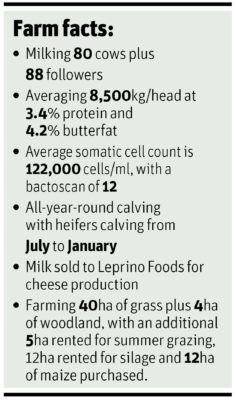
The system has remained largely unchanged. The herd is milked twice daily through a 12/12 herringbone parlour. Cows are strip-grazed for as long as conditions allow, typically from March until October, and receive a buffer of 13kg of grass silage and 2kg of Trafford Gold per head per day. Hannah believes grazing cows at 500ft on hilly terrain keeps feet and mobility in check.
During the winter, cows are housed in straw yards, although Hannah hopes to install cubicles before this winter. The winter ration comprises grass silage, maize, fodder beet, rapemeal and wheat. Cows are fed to yield inside the parlour, averaging 5kg/head daily of an 18% protein nut.
“When I started, the milk price was 48ppl and I thought it was easy.”
While Philip previously ran pedigree Holstein stock bulls, Hannah has introduced artificial insemination (AI) on milkers to accelerate genetic gain. Current sires include Pinetree Pursuit, Stanton’s Chief, and Koepan Oh Robin Red.Bitten by the pedigree bug; a passion she shares with Philip, Hannah has invested in foundation females from world-renowned cow families to establish her Whirlwind prefix.
These include the Zip and Rhapsody families from Sterndale Holsteins; Amy, Star, and Savoire Faire from Whinchat; Molly and Lianne from Hawksmoor; Nugget and Dusk from Aintree; Roxy and Missy from Wilsbro; and Melody and Zandra from Woodmarsh. The best cows receive three services to sexed semen before being mated to beef. Anything not up to grade is served straight to beef.
Heifers are run with a pedigree stock bull for ease of management. Hannah says the greatest challenge is milk price volatility. “When I started, the milk price was 48ppl and I thought it was easy,” she says. “Within six months, the milk cheque crashed to £12,000/month and reality hit. It didn’t even cover my rent and feed.”
 Milk price volatility required Hannah to rethink cows and cashflow; having Philip’s support was a big help
Cash flow
Currently receiving 28ppl, she has reduced costs by culling more aggressively, and closely monitoring cash flow. “The most important thing is to talk to people you owe money to and have a plan,” she explains. “I’ve found people are willing to work with you because they want to see you succeed, but you must keep to
your word.”
While at times the reversal of roles can be difficult, having Philip’s support is a big help. “I sit down every month, and we work out my debt versus assets, and if my assets are higher than my debt, I know it’s okay,” she says. “If I sell up, I must be left with something because I’ve put in too much work not to.”
For Philip, seeing the farm continue under Hannah’s stewardship has helped rekindle his enthusiasm for dairying. And he encourages more farmers reaching retirement to consider giving a new entrant an opportunity.
“It gives me great pleasure, and I’m very proud of what Hannah has achieved, because farming isn’t easy,” he adds. For young farmers starting out, Hannah says self-belief is essential. “That self-belief keeps you going through the darkest times. Talk to people who inspire you and learn from them. I do sometimes wonder if my life would have been easier if I had gone to university, but I don’t regret my choice. I love the lifestyle, and I’ve met and been supported by so many people – the farming community is incredible.”