

Mastitis severity is often driven by how a cow’s immune system reacts, says
Dr James Breen at Nottingham Uni
Most producers have had it – a sudden and unexpected case of toxic mastitis in a freshly calved cow, sometimes curable, sometimes fatal. But why are there different responses to treatment, and why do some cows seem more susceptible? British Dairying reports.
AHDB’s benchmark is that no more than one in 12 cows should develop a new case of clinical mastitis in the first 30 days of a lactation. And should cases occur, the infection likely originated in the dry period, when environmental pathogens, like E. coli, enter the teat end before or as the keratin plug forms. Here, they can multiply rapidly, releasing endotoxins into the cow’s system at the time of calving.
“Much of the damage in severe cases comes not from the bacteria themselves, but from the cow’s inflammatory reaction to these toxins,” says Dr James Breen, Associate Professor at the University of Nottingham School of Veterinary Science.
“It’s a case of striving to control the controllables.”
“Some cows mount a rapid, effective response and clear the infection with only local udder inflammation. Others develop an excessive systemic inflammatory response, leading to fever, shock, dehydration, and sometimes death.”
What, if anything, determines the outcome, and how can we both prevent these cases from occurring and effectively support a cow with severe mastitis? A good starting point is establishing when any early lactation cases have originated and what the pathogen is.
“We know, from farm and lab records, that drying off can be a ‘risk period’,” says James. “A high-yielding cow will be going through sudden and significant changes at dry off, which will put pressure on the udder and its natural defences. And while the udder can do amazing things over the dry period – when the process of involution allows it to regress, rest, and regenerate for the next lactation – if we don’t provide a clean, hygienic environment, that teat end and udder are at risk.”
Examining practices
Looking at herd hygiene and management practices could give indications as to what’s going wrong. “A robust drying off protocol will help – are dry cow therapies or teat sealants being infused properly in an aseptic manner? After drying off, is there sufficient bedding? What amount of feed space is there per cow? Are dry cows managed at pasture? All these are factors that can significantly affect the risk of mastitis infection during the dry period,” he says. “In many ways, it’s a case of striving to control the controllables, as that way there are likely to be fewer surprises.”
Cow condition, immune status, ability to deal with the increased energy demands of late-stage pregnancy; as well as any metabolic disorders, are all factors that impact how well a cow deals with bacterial challenge.
Factors impacting immunity during the dry period include:
- Immune function is naturally suppressed at this time
- Energy demands are increased as dry matter intake decreases
- Metabolic disorders like ketosis or hypocalcaemia can impair immune defences.
As a result, a bacterial challenge that would cause mild mastitis in a mid-lactation cow may become life-threatening in a fresh cow. “A high-yielding cow is navigating a fine balance between maintaining feed intakes and reducing the risk of fat mobilisation during the late stages of pregnancy, and external challenges, like pathogens in the environment,” says James. “Once calving has occurred, it can be a very rapid decline from a cow being ‘ok’ to ‘not ok’ and, if intervention is not swift enough, this could be fatal.”
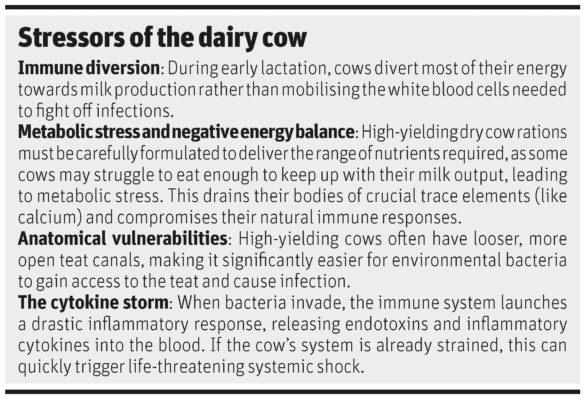
In the worst cases, bacteria multiply rapidly in the mammary gland and release large amounts of endotoxin.
This triggers a whole-body inflammatory response that can cause:
- High fever or low body temperature
- Depression and weakness
- Reduced rumen function
- Severe dehydration
- Low blood pressure
- Septic or endotoxic shock.
“Interestingly, two cows infected with similar numbers of E. coli may have very different outcomes because the severity is often driven by how their immune systems react to the endotoxin rather than by the bacterial count alone,” explains James.
“This really is the time to seek veterinary input.”
And not all coliforms are equally pathogenic; for example, Klebsiella bacteria can often be associated with severe systemic illness.
Factors include:
- Ability to multiply rapidly in milk
- Endotoxin production
- Resistance to the immune defences of the cow
- Virulence traits that help bacteria survive within the udder.
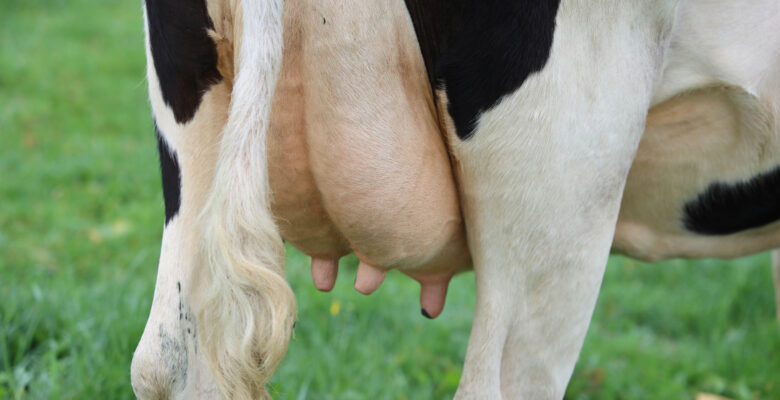 High-yielding cows often have looser, more open teat canals which
can make them more susceptible to infection
“The difference between a mild case and a fatal case is usually the result of the interaction between bacterial virulence, infectious dose, the cow’s immune and metabolic status, and how quickly supportive treatment is started,” says James.
Early intervention can affect outcomes dramatically.
Prompt treatment may:
- Correct any dehydration
- Control inflammation with Metacam, which is a non-steroidal anti-inflammatory
- Support circulation
- Prevent progression to toxic shock.
Seeking advice
Cases picked up only after the cow becomes systemically ill are more likely to be severe. “Herds with dry period environmental challenges may have poor apparent cure rates because cows that are infected at dry off may cure one infection, but become re-infected before calving,” he adds. “This really is the time to seek veterinary input and re-examine what you do around drying off and for freshly calved cows. Your vet will be able to examine recorded data on cell counts, pathogen testing, body condition, the ration, the dry cow shed and calving pen, and advise on tweaks to make and preventative measures to consider.”