
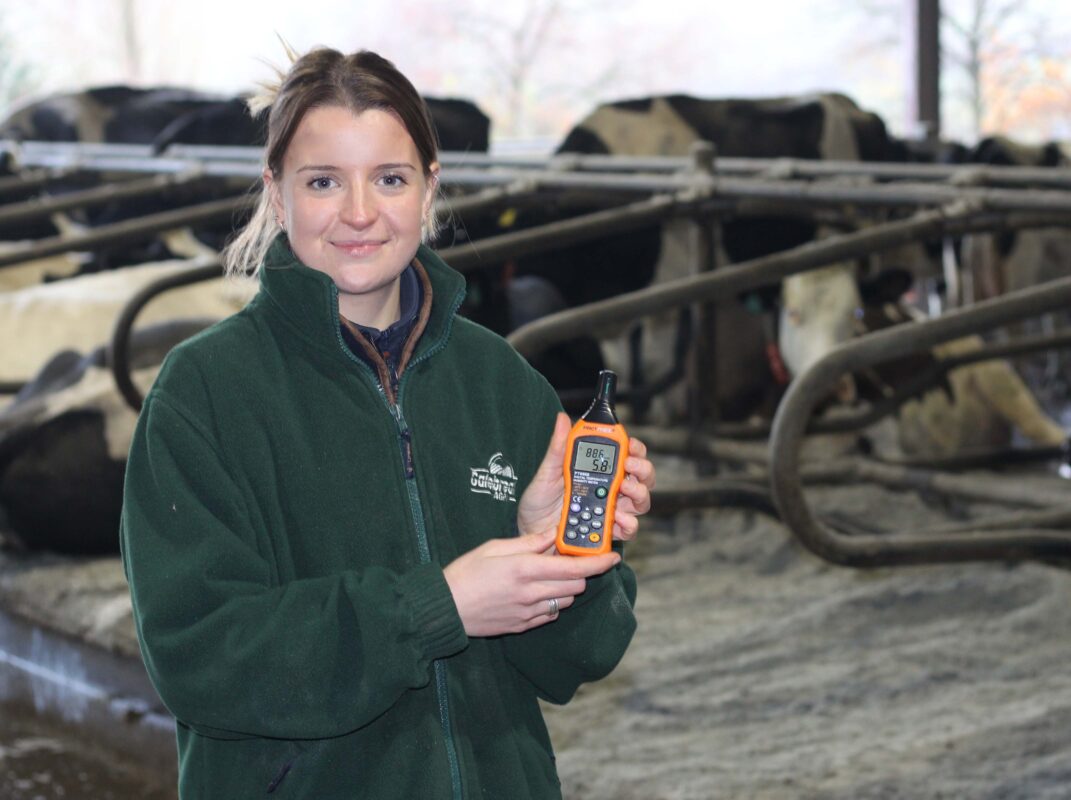
Galebreaker’s animal welfare specialist Chloe Rodriguez with a THI sensor
Following three successive heatwaves, it might be time for producers to consider future-proofing buildings and making management adjustments to mitigate heat stress.
A two-year project has investigated farmer attitudes towards heat stress as well as its impacts across 23 housed dairy herds in Scotland and Cumbria. The project, which was undertaken by Galebreaker, Scotland’s Rural College (SRUC) and Smartbell, was funded by the Digital Dairy Chain.
The study aims to shift dairy farmers’ perception surrounding the risk of heat stress. It uses local data to visibly demonstrate the knock-on effects that badly ventilated housed environments can have on herds in the north of the UK.
“If you do not monitor it, you cannot manage it.”
“There is so much power in showing farmers real-time data of what is actually going on in their local area,” says Chloe Rodriguez, Animal Welfare Specialist at Galebreaker. “Much previous heat-stress research has come from America, the Middle East or southern England, so there’s a real gap in the relevant information currently available to UK farmers.
“The Analysis of Scottish Housed Environments for Dairy (A-SHED) project aims to understand more about the risks of heat stress throughout Scotland and northern England by expanding on Galebreaker’s existing live network of temperature-humidity index (THI) monitoring.”
The THI combines temperature and relative humidity into a single value to represent the level of heat stress experienced by an animal. Humidity is important when quantifying heat stress, because at higher humidities, the effectiveness of evaporative cooling (through sweating or panting) reduces, making it more difficult to regulate body temperature.
And humidity is often the missing link in the assessments being made on farm. “Many people don’t know when their cows are affected by heat stress,” says Dr Laura Shewbridge Carter, Researcher at SRUC.
“At one of our project meetings, 14 farmers arrived adamant heat stress was not a local issue. By the end, several wanted THI sensors installed in their sheds, as we were able to show that cows can struggle even at lower temperatures when the humidity is high,” she says.
When humidity and restricted airflow limit heat loss, cows may breathe faster, lie less, bunch around water or fresher-air areas, and lose yield. A-SHED data indicates that a THI above 67 is associated with reduced milk yield. “It’s important to remember that lactating dairy cows produce a lot of metabolic heat and high THI levels within the building restrict the cow’s ability to dissipate excess heat,” says Laura.
The problem does not disappear at sunset. A-SHED found some buildings were hotter at night than during the day. And facilitating cooler night-time conditions helped cows recover some lost yield, highlighting the importance of managing them beyond perceived daytime peaks.
External conditions are only part of the equation. Livestock housing in the North of the country is often designed to protect cattle from wind, rain and winter draughts, but it can be difficult to release heat and moisture from enclosed structures in warm, humid weather.
The project identified one farm building where the THI was consistently around four units higher than the regional average, leaving cows particularly vulnerable to heat stress. “This particular shed had an open ridge which provided an outlet, but a multi-pitch roof, Yorkshire boarding and lack of mechanical ventilation were leading to restricted fresh air intake,” Chloe says.
“The roof also had clear panels covering around 30% of the roof, which increased temperature through solar gain. In addition, the stocking density of 5.2m² compared to the AHDB guideline of 10.5m² contributed to further temperature and humidity pressure inside the building.”
When the research team carried out a smoke test in the shed, it took four minutes and 35 seconds to clear, an indication of slow airflow and heat removal. A well-ventilated shed should clear in around a minute. “Every shed tells a different heat-stress story based on its design and positioning,” says Chloe. “Orientation, inlet area, ridge design, roof pitch, solar gain, stocking density and internal obstructions all affect how fresh air enters and warm, humid air escapes. This helps explain why two sheds in the same region can present different risks.”
Understandably, cost remains a major obstacle when optimising buildings, with 78% of farmers citing capital cost as a barrier to implementing mitigation solutions, while 59% mentioned limitations in existing shed infrastructure. Return on investment, labour and limited information were also concerns.
The data strengthens the case against a one-size-fits-all solution. Before investing, farmers must identify whether the constraint is inlet area, ridge capacity, solar gain, stocking density, overnight management or cow-level air movement. “If you do not monitor it, you cannot manage it,” says Laura.
SRUC’s milk analysis separates first-lactation and older cows, then divides each into early, mid and late lactation, helping identify groups under different metabolic and pregnancy-related pressures. “We’re seeing considerable variation between buildings, and by simultaneously monitoring milk yield we can show how heat stress correlates with reduced productivity,” adds Laura.
Climate-resilience planning
The project partners are turning this evidence into farm-specific feedback and data to support longer-term climate-resilience planning. For farmers, the practical starting point is to measure the conditions cows are experiencing, assess how the shed handles heat and humidity, and target improvements where they will make the greatest difference.
Galebreaker can support farmers with THI monitoring, building assessment, ventilation advice and practical mitigation planning. The aim is to help farmers invest where it will make a difference to cow comfort and performance.
A weather forecast can tell you what is happening outside. A-SHED is showing why farmers also need to know what is happening inside.