
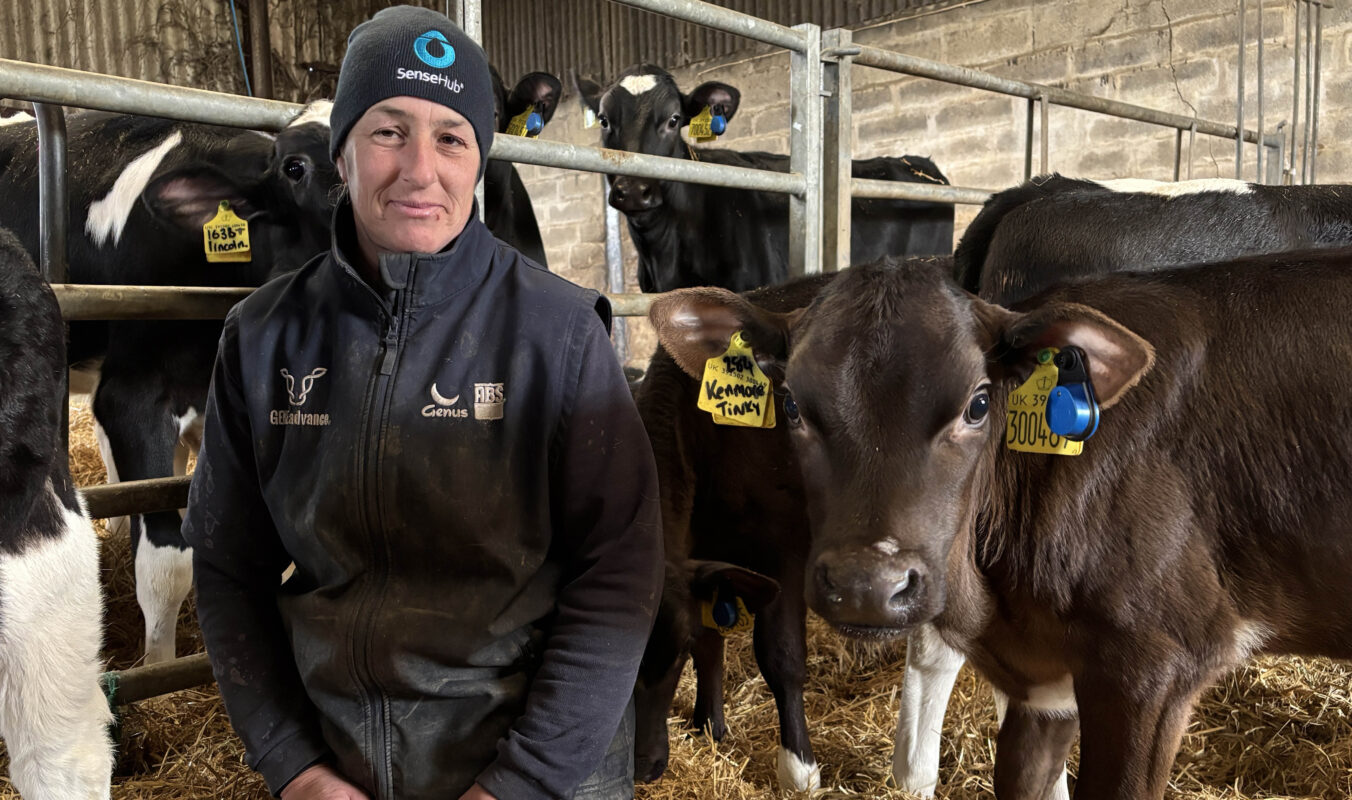
Lynn Pridham and her husband Ian introduced a smart ear tag system for monitoring the youngstock
Making use of technology has enabled two new entrants to save time by monitoring their dairy herd with limited staffing requirements. British Dairying discovers more.
Over the past three years, Ian and Lynn Pridham have built a new dairy herd of 250 cows. With an ambition of expanding to 350 cows, the husband-and-wife team have installed a herd monitoring system to oversee cow and calf health and fertility, and to ensure every animal receives the care it needs from the
farm’s limited workforce.
In addition to running a beef suckler herd and finishing unit near Launceston, Cornwall, Lynn and Ian have recently established their new dairy herd at Norton Farm, Bodmin. In the three years since they took on the farm tenancy, they have rejuvenated a large percentage of the farm’s grassland with herbal leys and have rapidly expanded to 250 cows.
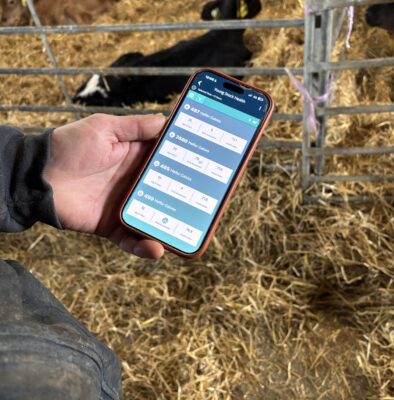 The app highlights any calves that need attention
“Our dairy project started when we bought 30 in-calf heifers,” Lynn; an experienced artificial insemination (AI) technician, explains. “On our first day of milk production, we were only milking one heifer, but we quickly expanded by purchasing another 70 in-calf heifers and 40 cows, with the remaining 110 animals bred at home using sexed semen.”
The herd calves in three distinct blocks – a spring group of 60 animals calve in a nine-week window starting in the first week of January, followed by a group of 100 which calve between June and September. A third group of 90 then calve from October to December.
Aim to modernise
“Our aim is to reach 350 cows, but to do that we’ll need to modernise some of the farm’s facilities,” Lynn explains. “We’re talking to our landlord about building a new cubicle shed to replace the farm’s loose housing facilities, and we’ll eventually install a sorting gate to automatically draft cows for AI, treatment or inspection. For now, though, we’re managing with what we’ve got, which means making sure we do everything as efficiently as possible.”
To improve heat detection, the Pridhams installed a herd monitoring system in early 2024, with all cows equipped with their own individual SenseHub collar. “Apart from Ian and myself, we’ve only got one part-time farm worker and a couple of relief milkers,” Lynn says. “So our biggest challenge since day one has been finding enough time to make sure the herd is managed properly.”
The lack of labour was especially tricky to manage during the herd’s first year, as the couple were still living 20 miles away at their home farm beef unit. “From the outset, I simply didn’t have time to apply tail chalk, and with so few people on the farm, there was a danger we’d miss too many heats,” Lynn notes. “So we installed SenseHub as soon as we could to detect heats accurately and to make sure AI was done at the optimum time to conceive from sexed semen.
“As a result, even though we’re still expanding the herd, we’ve produced too many heifer calves because our breeding programme has been so effective. We’ve therefore started genomic testing to ensure we’re only using sexed semen on the best animals to breed the next generation of replacements.”
“Each calf is fitted with an ear tag within 24 hours of being born.”
The primary reason for installing the collars was to detect heats and to highlight any fertility-related issues. But it soon became apparent that the system’s ability to identify signs of other health issues was just as beneficial.
“In September 2024, during a late heatwave, the collars told us that a group of 20 cows were suffering from heat stress,” Lynn says. “We hadn’t seen any obvious signs of distress, but thanks to the early warning we were able to act before the problem got too serious. We installed a fan and opened the sides of the housing shed to improve air flow, delayed afternoon milking by a couple of hours and fitted garden sprinklers to keep cows cool when standing on the collecting yard.
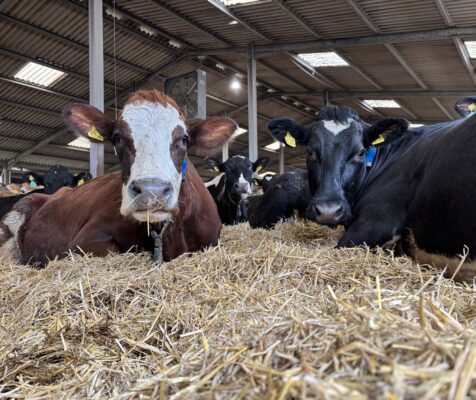 The couple also introduced smart collars to help with herd monitoring
“The app can’t tell us what’s wrong with a sick animal, but by warning us that something isn’t right, we can investigate sooner,” she adds.
“In terms of mastitis, we’re treating cows as much as four days before any symptoms appear, which means a course of non-steroidal anti-inflammatory drugs is usually enough to provide effective treatment without having to resort to antibiotics. We’ve reduced antibiotic usage by about 10%, and we’re no longer tubing everything at drying off. Instead, we’re being more selective with dry cow therapy, which is better for the cows and our cashflow.”
In addition to the collars which monitor adult cows and heifers, the Pridhams have also introduced SenseHub ear tags to the herd’s youngstock population. “Because we are such a small team and our relief staff haven’t got much calf rearing experience, we decided to upgrade our subscription to include youngstock monitoring,” Lynn explains. “Each calf is fitted with an ear tag within 24 hours of being born so that we can monitor its health and performance from day one to the end of its final lactation.
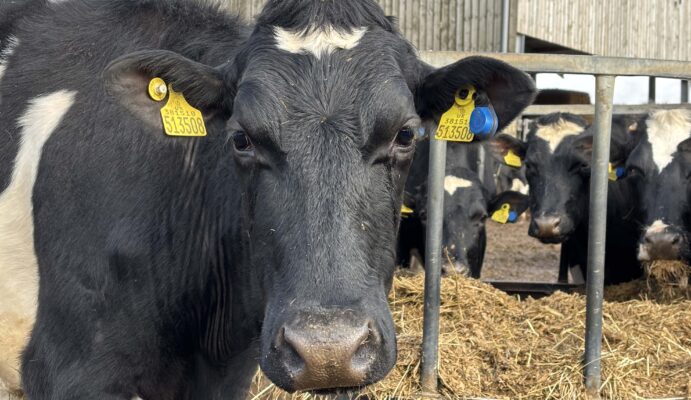 The ear tags can monitor performance the whole way through a cow’s life
“As soon as I wake up, I look at the app on my phone to see if anything needs urgent attention. Then, when I’m feeding the calves, I have a quick scan around the youngstock shed to see if any of the ear tag lights are flashing,” she explains.
“That tells me everything I need to know without having to spend too long looking for symptoms like drooping ears, laboured or excessive breathing, or a calf which isn’t drinking or eating properly. It saves a lot of time every day and gives me extra peace of mind knowing that the entire calf population is being monitored 24/7 instead of for a few minutes a couple of times a day.”
Warning signs
Even if a calf looks fine and isn’t displaying any obvious signs of distress or illness, if a tag is flashing or a calf has appeared on the youngstock health report, there will almost certainly be something brewing, says Lynn. “I can then keep an eye open for what’s wrong and treat it before a minor upset becomes a major problem.
“We wouldn’t be able to do what we’re doing without it,” she adds. “Without the collars and tags, we would need more staff and would probably need to employ a full-time herd manager, which we simply can’t afford. We rely on the system to make the working day manageable and less stressful, and to keep the entire herd productive and healthy.”