
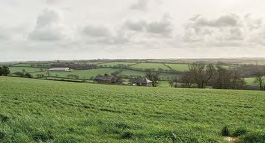
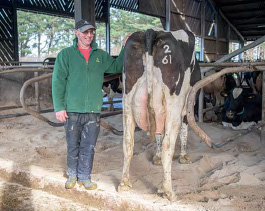
In this month’s RABDF/NMR Gold Cup Comment, Paul Broad discusses how he’s managing a difficult season of drought and ensuring there’s enough forage in stock.
There is only one topic to start this month’s article with and that’s the good ol’ British weather. When speaking to non-farming people, they never seem to look at the weather forecast; when they want sun, they jet off overseas to top up their tan. But I, along with thousands of other farmers, have been looking at forecasts for the past two months wondering if it will ever rain again.
Writing this on August 19, it’s our third wet morning in a row, and the weather has turned, with more showers forecast over the next 10 days and temperatures back to normal. Last year after the dry spell we had over 250mm of rain in September to kick start everything back into life again, but with it being both drier and hotter this year we are going to need more than a few showers to make the grass green again.
We have some round bales of hay in the shed for the heifers, enabling us to keep the good silage for the milking cows. Our silage fields will be topped off and fertilised as there is more rain to come – hopefully the grass will then regrow from the bottom of the sward, giving us one or possibly two more cuts. I hope we will have enough grass silage to take us through winter but there will be less to carry over for next summer. When the ground softens up, we have grass seed to sow along with more acres of cover crops to give us a larger first cut next year.
Even some of our maize crops on the top of the hills are struggling this year, but the majority is still green and will produce a good tonnage. We have built up a good buffer of maize silage in the clamp, with enough of last year’s crop to take us through to February 2027. This is a great position to be in, but we will need to grow more maize next year.
Easy harvest
How does the old saying go? Pity dry weather does any harm. Our winter wheat was cut in July at 8.75t/ha and we had 6t/ha of straw; it was a very easy harvest as we could leave the straw on the ground for five days and not worry about it getting rained on. The quality of the grain was average, but with some small, shrivelled grains due to lack of moisture. The only thing we’re saving money on at the moment is the amount of diesel we’re using in the straw bedder tractor, as the straw is that good this year.
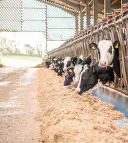
The heat and humidity this summer have taken their toll on the cows, with feed intakes varying from day to day. This has impacted milk yield and quality, and fertility has decreased, with more cows bulling when they should have been 60-100 days in calf. The financial consequences of this will be felt for the next 12 months. I am glad I am not a block calver and wanting to calve everything in 12 weeks; we can live with some cows losing time in our all-year-round calving system.
Battling bluetongue
And now bluetongue has reared its ugly head. We haven’t vaccinated our herd, but we have had a couple of cows look ill – we blood tested them, but they came back negative so we gave them anti-inflammatories and they are fine again. I think cattle cope with the disease, but it is proving to be devastating for sheep farmers. One sheep farmer I know said sheep don’t need a reason to die and now they’ve got bluetongue too. If we are going to have hotter and drier summers the whole industry has many new challenges ahead.
One challenge we have completed is our farmhouse renovation. Last August, Tom, our builder, had finished my son David’s new house and said he had time to renovate our farmhouse. You know how it goes on the farm – all the important things like sheds, slurry pits, and new tractors take priority when you’ve got some money to spend. Our house hadn’t had any money spent on it for the past 20 years, so when Tom said he had the time and the milk price was looking pretty good we decided to go ahead, much to my wife Wendy’s delight.
Like every project we have had a few ups and downs and extra costs along the way. We started upstairs by insulating the outside walls, adding a new wet room and ensuite bathroom for my son Philip, and installing new central heating and electrics. By Christmas Wendy and I had to move up to my mother-in-law’s house as it was no fun living in a house with no heating or hot water.
Structural issues
That’s when all the fun and games started; the builders took down the dining room ceiling and wondered how the bedroom above had stayed there, as all the timbers had rotted. We also found an unused chimney that went up to the eaves of the house – we had to get a structural engineer in to make sure it was safe to remove it.
After sweeping the chimneys and having a new liner put in one, they condemned our two wood burners, so we had to get new ones. On the ground floor we installed underfloor heating and sold our Rayburn. A new kitchen, carpets and decorating followed, and we finally moved back in at the beginning of August. Wendy is absolutely delighted with everything and I’m in her good books – for the time being.