
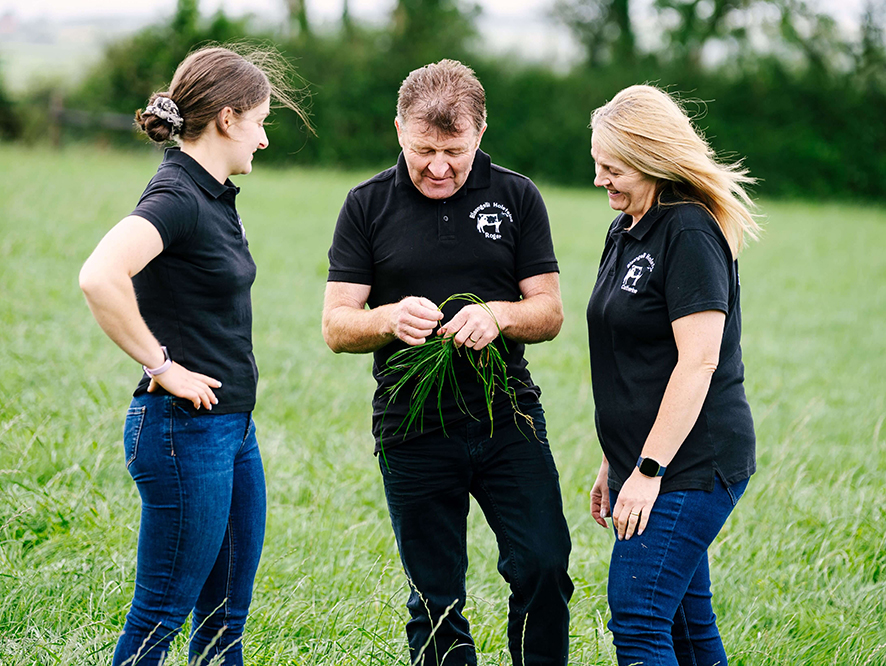
(L-R) Sarah, Roger and Catherine Howells have undertaken a farm audit
Blaengelli Farm in west Wales is one of 685 farm businesses who have taken part in an unprecedented environmental assessment, which aims to support farmers to measure and improve the sustainability and profitability of their farm. British Dairying reports.
Roger and Catherine Howells, alongside their daughters, Emma and Sarah, milk 148 pedigree Holsteins across 142ha of grassland at Blaengelli Farm near Whitland, Carmarthenshire.
Over the past decade, the family has steadily invested in infrastructure to maintain high levels of animal welfare, which in turn has helped lower their carbon footprint to 1.06kg of CO2 equivalent (CO2e) per kg of fat and protein corrected milk (FPCM). That’s well below the national average of 1.2kg.
Holistic view
Yet, despite the environmental improvements made to date, the Howells still sought a more holistic view of the farm’s impact. So when the opportunity arose to take part in a new assessment by the Soil Association Exchange, funded by Lloyds Banking Group, the family decided to take part.
“As part of our contract with our milk processor, we’ve taken part in sustainability audits for the past five years, so we’re pretty well versed in this area,” explains Roger. “However, we saw this as an opportunity to build a full picture of the farm and thought it might support us in looking more closely at our soil health. We knew the assessment looked at soil pH, phosphate and potash alongside copper and magnesium levels, which we hadn’t done before.” The assessment scored the farm performance across six areas: Soil, biodiversity, animal welfare, water, carbon, and social impact. Thanks to a keen focus on herd management and disease prevention, which has been instrumental in driving the farm’s overall efficiency and sustainability efforts, the Howells scored high on animal welfare.
 The family have found improving soil health has benefited the forage
Animal welfare
“We’ve steadily invested in developing our farm’s facilities with the help of Lloyds Bank. To start with, eight years ago, we built a 320-cow cubicle shed to house milking and dry cows,” says Roger.
Previously, the dry cows and in-calf heifers were housed together at a separate farm and fed baled silage. The new shed enabled the team to feed a bespoke dry cow diet to cows six weeks pre-calving, which has improved cow health exponentially.
“They are fed grass silage, 5kg of chopped straw and a dry cow blend containing minerals,” says Roger. “Previously, milk fevers in autumn-calving cows were as high as 50%, which was disheartening, but now they are negligible.”
“We now have a roadmap to follow.”
He recognises that healthy cows are more efficient, requiring fewer resources and producing fewer emissions, which directly supports the Howells’ wider sustainability goals.
“Cows are routinely foot-trimmed at drying off and 100 days in milk. We’ve also invested in an automatic footbath to make it easy to footbath cows twice daily after each milking,” he explains. As a result, lameness cases are low, running at 15 cases per 100 cows, down from 34 cases in 2016/17.
Meanwhile, mastitis averages 26 cases per 100 cows, back from 46 cases in 2016/17, owing to better housing and attention to detail. From a breeding perspective, good management ensures youngstock first calve at the optimum age of 24 months, and the herd’s pregnancy rate is running at an impressive rolling 12-month average of 33%.
“We decided to invest in heat detection and rumination collars, which have helped lift conception rates to 46%,” says Roger. “We also undertake bi-weekly vet visits to pregnancy diagnose cows.”
Soil health
When it comes to the soil health element of the audit, it found the farm had excellent soil structure, being crumbly, porous and open. This allows good air and water movement, lending itself well to good quality homegrown forage, on which the family have focused heavily in recent years.
“Six years ago, we gained the confidence to buy a neighbouring farm when Sarah returned home to work here full-time,” explains Roger. “Through this we increased our land mass and became much more self-sufficient in terms of home-grown feed.
“Today, the cows are fed a simple diet of grass silage, straw and minerals. They’re milked twice daily and produce yields of 11,000kg/cow per year. The milk produced is also good quality, at 4.1% butterfat and 3.3% protein.” The family
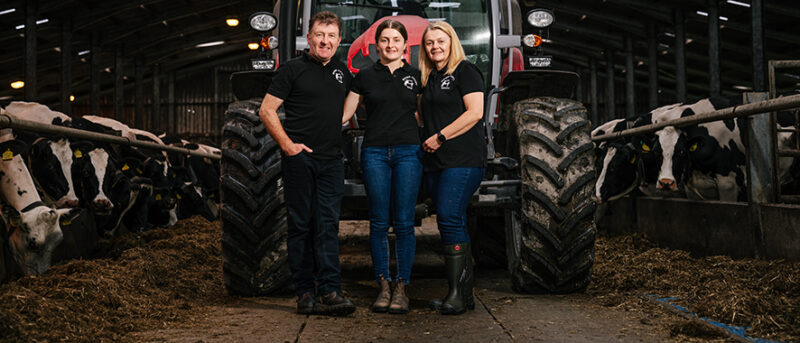 The Howells focus on improving animal welfare which in turn has reduced the farm’s carbon footprint
The family also use low emission spreading equipment to reduce ammonia emissions when applying slurry, and carry out soil testing to create a bespoke prescription for each field based on its nutrient requirements.
Environmental improvements
Following the audit, tailored action plans were produced to guide the Howells toward identifying where environmental gains and operational efficiencies can be made. They were also signposted to further funding options for taking up certain environmental improvements.
Sadly, a recent TB outbreak has forced the family to keep twice the usual number of youngstock to replace lost animals, which has doubled their replacement rate from 25% to 50%. The increase in methane emissions because of this has resulted in CO2e emissions rising to 1.27kg of CO2e/kg of FPCM.
“It’s very frustrating because it’s something we feel is completely outside our control,” says Catherine. “I don’t think people outside the agriculture sector fully understand the knock-on effect TB has on farm businesses or farmers’ mental health.”
Making gains
Despite this, they are determined to continue making gains in other areas, particularly in soil health, following the assessment’s key recommendations for further improvements.
These included introducing clover to reduce nitrogen inputs, applying farmyard manure to low-phosphate fields, and planting deeper-rooting grasses and legumes to boost soil organic matter and carbon capture. Low worm counts revealed that the pH also needed to be raised on some fields to improve fertiliser efficiency. “We’ve already started applying farmyard manure to low phosphate and potash fields to correct indices and plan to apply lime to fields that weren’t at the optimum pH at the time of testing,” says Roger.
“It’s fantastic we now have a roadmap to follow to give us future focus. We’ll be working with our agronomist to further refine our nutrient management plan.”
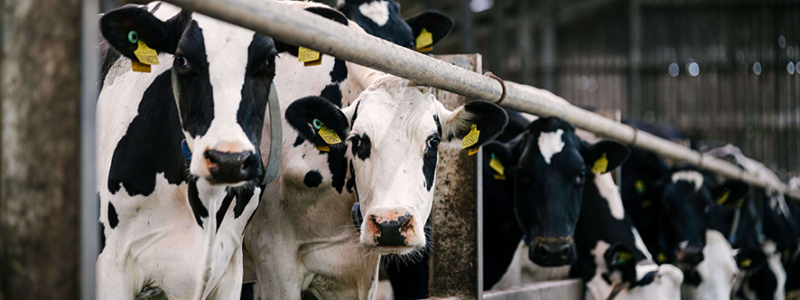 Healthy cows are more efficient, requiring fewer resources and producing fewer emissions