

Eleri and Gethin Gibbon have paid close attention to forage, including the making and ensiling of grass silage
Producing good-quality forage and a consistent diet is paying dividends for one autumn block calver seeking profitable and healthy cows in West Wales. British Dairying reports.
Placing an unwavering focus on forage quality has helped one Welsh dairy farming family achieve an impressive margin over purchased feed of 37ppl this winter.
Gethin and Eleri Gibbin milk 350 autumn-calving cows across 202ha at Drefach Farms, near Whitland in Carmarthenshire. Their cows are on target to produce 10,000 litres/head at 4.45% butterfat and 3.45% protein this year, with milk sold to Leprino.
“You don’t always have to buy expensive things.”
The system is reliant on high quality forage – they strive for 60% forage in the winter ration to maximise margins. Cows are fed a high-performance total mixed ration (TMR) from calving to turnout in March to hit strong peak milk yields. They then graze for 120 days to reduce ration costs as they enter mid and late lactation.
Gethin says: “We want profitable and healthy cows that can comfortably give 10,000 litres while grazing for one-third of the year. We could go chasing milk and not be any better off.” This attitude has served the business well, and as a result, the Gibbins have been able to invest in renewable energy and modern facilities. Five years ago, they erected a new dairy building costing £1.5m, including a 50-point rotary parlour, 330 cubicles and a straw pen for dry cows. It has a 1m-gallon underground slurry store and polycarbonate roof sheets, which contain a UV layer to reflect heat.
The Gibbins opted for an internal perimeter feed fence to protect feed against the weather. It provides each cow with 90cm of feed space, allowing the whole herd to eat at the same time.
The new building replaced 250 cubicles and a 16/32 swing-over parlour. The older cubicles are now used for youngstock; previously youngstock and dry cows were reared at another site, but it has enabled the family to house everything at the dairy. Gethin says it has made more efficient use of forage. “At the other farm, we fed baled silage for ease, but now we can now feed heifers higher-quality clamped silage.”
The Gibbins aim to make good quality homegrown forage to minimise bought in feed, with cows fed 3t of concentrate per cow/year. Typically, autumn triticale is grown after maize. After wholecrop is taken, fields are reseeded with grass.
Growing conditions
“We have grown maize after grass for the past two years because we had suitable blocks of ground, but we won’t grow any this year,” says Gethin, adding that growing conditions can be marginal. This year they plan to either purchase forage maize or caustic-treated wheat to add starch to the diet. Anwen Jones, Lallemand Animal Nutrition’s Regional Business Manager for Wales, has been working with the Gibbins for the past five years, advising them on nutrition. “Wholecrop is high in starch, which complements the winter ration and fits in nicely with the farm’s rotation,” she says.
To help maximise forage quality, the family aim to cut grass every five weeks from April. They apply approximately 1,200 gallons/ha of slurry to the first cut using a dribble bar alongside 70 units of nitrogen fertiliser, which is reduced by 10 units after each cut.
Anwen takes grass samples one week before cutting to check nitrate and sugar levels. “It allows us to monitor if it’s safe to harvest the crop because high nitrates will affect fermentation, resulting in unpalatable silage,” she says. “I also look at grass fibre levels, because as this goes up, nutrient quality quickly diminishes. Once neutral detergent fibre (NDF) levels hit 38-42%, and the weather allows, we want to get the grass off.”
 The forage wagon’s longer chop length can make it more difficult to ensile
Last year, the couple used a forage wagon after being let down by their contractor. Although fortuitous, they believe it has been a good move because quality has been exceptional. “We spent 40 years using the same contractor and it was out of desperation we used the forage wagon, but sometimes things happen for a reason,” says Eleri.
Layered in the clamp
Grass is left to wilt for 24 hours maximum to avoid nutrient losses. The forage wagon’s longer chop length can make it more difficult to ensile, so grass is layered in the clamp ‘like a lasagne’ in six- to seven-inch layers and consolidated well using a compactor and loading shovel. “It needs dispersing because there’s a risk of more air pockets when ensiling,” explains Anwen.
Close attention is paid to not overfilling each pit and sealing the clamps well to aid good fermentation and reduce losses. The Gibbins use long side sheets which are folded to meet in the middle, followed by an oxygen barrier and a top sheet. They leave no stone unturned in the quest to improve forage quality.
 The 350-head Holstein Friesian herd are milked through a 50-point rotary
The clamp walls were coated with resin, but over the years, this has started to corrode. So, Gethin painted the walls using magnolia emulsion 10 years ago to give them a smoother finish and avoid tearing side sheets. “The walls still have it, proving you don’t always have to buy expensive things,” he says.
But Gethin doesn’t scrimp on silage inoculant. He has been using Lallemand’s Magniva range for the past four years. “We put 100% into getting the forage right. Using an additive is a no-brainer.” Farming just a few miles inland from the coast, the farm receives up to 60 inches of rainfall annually, and conditions can change quickly. It is useful to have a suite of products that are crop-and-condition-specific rather than using the one off the shelf, says Gethin.
“It makes sense using what the crop needs, not what we have on the farm at the time. Our silages are far more consistent since using the inoculant.”
Depending on weather conditions, one of three inoculants – Magniva Classic, Platinum Grass-Dry, or Platinum Grass-Wet – is used to match the dry matter of the grass silage. Eleri explains: “It doesn’t matter how well you plan, conditions can change quickly. We are trying to control the controllables; you can’t control the weather, but we can use a specific inoculant to help improve silage quality.
“Since we have started using the inoculant our silage quality has improved, and it has given us the confidence to be braver.”
On the advice of Anwen, they started layering cuts across the farm’s three pits and opening them all at once – something the couple say they feel confident to do because the inoculant prevents heating. This approach means the diet remains consistent for the 150 days of winter.
Last year, first cut was taken in late April, and the silage analysed at 32.4% dry matter (DM), 12.1MJ/kg of metabolisable energy (ME), and 18.8% crude protein (CP). The second cut matched this.
Meanwhile, maize was treated with Magniva Maize Elite and analysed at 11.4MJ/kg ME and 27.3% starch, while wholecrop was treated with Magniva wholecrop and analysed at 10.8ME and 35% starch. Gethin says winter milk yields have been more consistent because the ration never changes.
At Drefach, using an inoculant is vital but only part of the silage-making process from field to feed out. This starts with growing quality grass. Fields are reseeded every seven to eight years with Aber high-sugar perennial ryegrasses and 1kg of white clover.
“We challenge them to produce cheap milk from grass.”
Cows are transitioned to grass in March over three weeks with the TMR gradually reduced. They are paddock grazed on 12-hour shifts and receive no buffer feed, just cake in the parlour.
“By then, the cows have done two-thirds of their lactation and are back in-calf, so we challenge them to produce cheap milk from grass,” Gethin explains.
The Gibbins installed an underpass 10 years ago, which has enabled them to access another 40ha situated on the other side of a busy B-road, taking the grazing platform to 77ha. “We did it for safety more than anything because we had to cross cows over the road,” notes Eleri. “We also made it big enough to take the telehandler underneath.”
Six weeks pre-calving, cows are moved on to high-fibre grass and are supplemented with straw and haylage. For the final three weeks of the dry period, they move indoors and are fed a transition ration of low-potassium, baled silage made from fields that haven’t received slurry alongside a 24% protein dry cow nut containing methionine. Cows calve indoors over 12 weeks from August to October. “We start with heifers for the first month, followed by cows, and everything will have finished calving by November 1,” Gethin says.
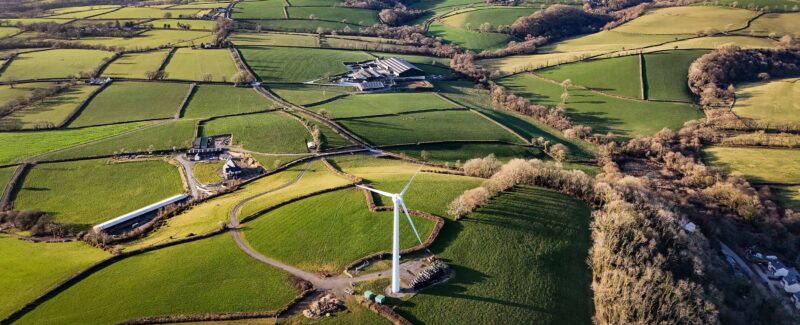 The 202ha that spans Drefach Farms, near Whitland contains a 500kW wind turbine and 50kW solar panels
Profitable lifetime index
He selects moderate-sized bulls with a good profitable lifetime index (PLI), health traits and high fat and protein to suit his constituents contract. The best cows are served with sexed dairy semen for five weeks, followed by Charolais, Wagyu and British Blue beef semen. “This year, we synchronised heifers and served the best ones to sexed semen, and then Wagyu bulls went in,” he says.
After calving, cows receive a TMR comprising 31kg fresh weight of grass silage, 10kg of maize and 6kg of wholecrop, alongside 8kg of a bespoke 22% protein blend, plus minerals. Daily forage intakes are averaging 15kg DM. Cows are also fed an 18% concentrate to yield, up to a maximum of 8kg daily in the parlour.
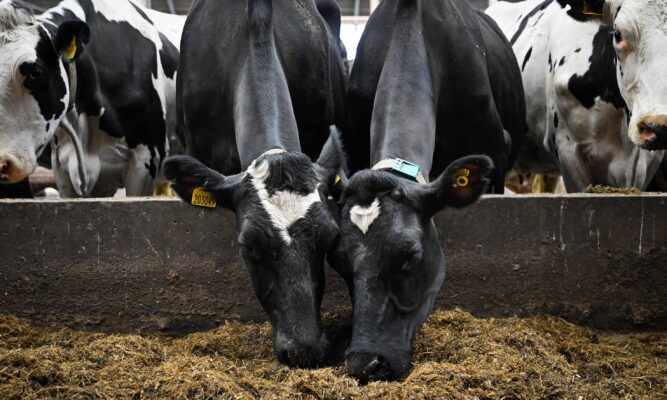 Cows are fed a high-performance TMR from calving to turnout in March
The yeast farm pack Levucell SC Rumignition is also used. This is a three-in-one product containing live yeast, inactive hydrolysed yeast and yeast cell wall to aid digestion, minimise acidosis and mitigate the effects of any pathogen or toxin challenge. It has been fed within the TMR at 25g/cow per day for three consecutive years at Drefach Farm.
“Because we are feeding wholecrop and maize, we’ve been using it as an insurance policy to mitigate potential mycotoxins threats,” explains Gethin.
“This winter, we fed 40g/cow per day because we had a bad starling challenge. Cows are healthier and performing well, and dung consistency has improved.”
Only four cows were treated for milk fever last autumn. Mastitis rates are running at four cases/100 cows, and only 10% of the herd is treated with antibiotics at drying off.
The Gibbins recently invested in the UK’s first Hetwin Aranom automatic feeding robot to reduce labour requirements.
Gethin fills hoppers and bins, and the robot positions itself underneath the feed kitchen where ingredients are dispensed into the horizontal mixing tub. It feeds 15 times in 24 hours, travelling around the shed’s feed fence using magnets placed under the floor’s surface, pushing up feed as it goes.

Since its installation in December, yields have lifted by three litres to 38 litres/cow per day and Gethin says the cows are more content.
Furthermore, it has saved 80 litres of diesel per week and two hours of daily feeding, which means calving and feeding can be run with two full-time labour units.
“Her advice has been invaluable, and we feel the herd is healthier.”
Currently, the herd’s feed conversion efficiency is 1.9, meaning cows are giving 1.9 litres of energy-corrected milk for every 1kg of DM intake. They are currently producing 3,800 litres of milk from forage, but because intakes have risen since the introduction of the robot feeder, this is expected to rise to 4,000 litres.
“Milk production is up significantly since Anwen has overseen diets,” says Gethin. “Her advice has been invaluable, and we feel the
herd is healthier.”
The Gibbins’ youngest son, Lewis, is currently in his third year at Harper Adams, where he is studying agriculture. He plans to return home when he completes his degree.
Although Gethin says they have no aspirations to milk ‘2,000 cows’, the direction of travel will be up to Lewis. “It will be up to him to drive the business the way he wants to take it forward. Thankfully, the business is in a good place to allow him to do that.”