
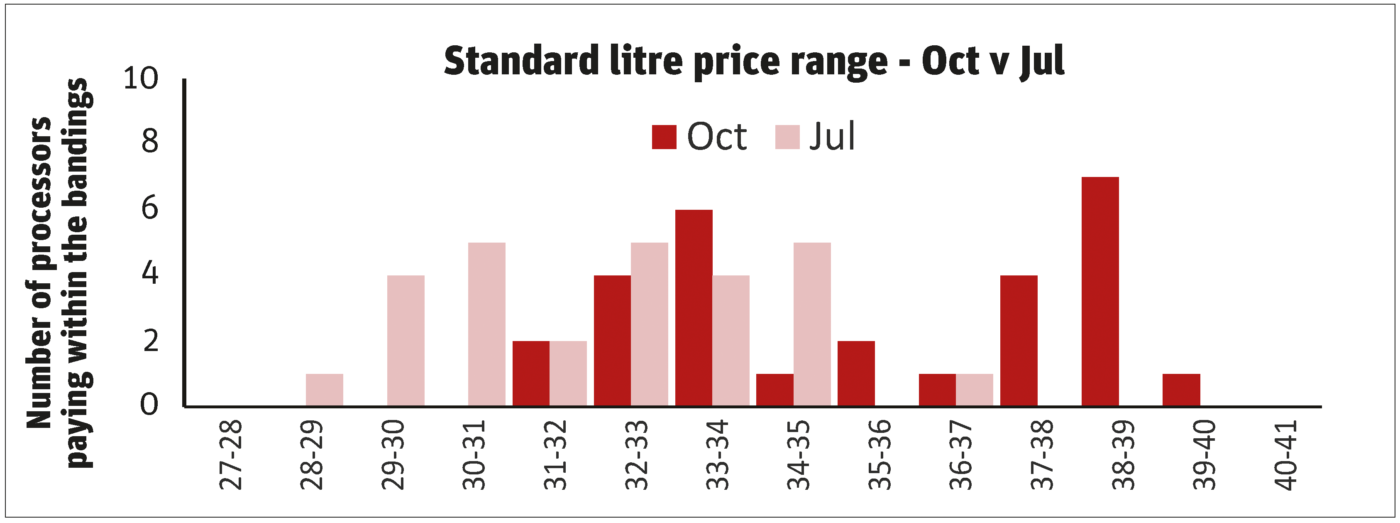
The prices have moved up the bandings compared to July, with six processors
paying between 38p and 39p
By Chris Walkland
I really don’t understand what’s happening at the moment in Europe. On the one hand the French Government is coughing up hundreds of millions of euros in drought compensation for its farmers. Some 65% of French land has faced drought conditions with crop losses of 50% or more, and up to 70-80% in some regions. Farmers there are already looking to buy forage from Ireland… but it is short there too. In The Netherlands and Germany river levels in the Rhine fell to their lowest ever, so they must
have been hit hard too.
On the other hand, the volume statistics aren’t bad at all. French milk volumes are tracking last year’s levels, and Germany’s are still higher than last year. Those in the Netherlands are up on 2025 too, and there doesn’t seem to be much concern there either. Perhaps this is why I am seeing trader reports which say they aren’t worried about milk flows at all. Yet. Certainly EU prices, particularly cheese, are not following the UK’s up, and EU traders are currently saying the EU dairy market is ‘balanced’.
“It’s too late to save the pasture on many farms.”
Here in the UK it is impossible to say our market is balanced, given the latest milk production volumes. Volumes are falling sharply, and the outlook is poor given the grass and maize situation, the fact that a lot of first cut forage has been chewed away, there’s bluetongue, and major cash flow pressures. Last year farmers had cash to supplement forage with bought-in feed to keep the milk flowing. This year they don’t.
If EU processors aren’t worried about milk then there is no doubt that UK processors are. The numbers say it all – over the past 14 days GB volumes are down around 4.5%. Some firms are down by a much larger extent, too. The total milk produced in the UK over the 50 days from July 4 to August 22 was 1,963m litres, which is down 64.6m litres and 3.2% on last year. In GB, over the same period volumes were 1,597m litres, which is down 4% on last year. And if we take the comparison further… GB volumes were down 1.2% on the three-year average, including 2025’s record high levels, and within 0.5% of the three-year
average excluding 2025.
The prospects aren’t great, either. The rains may have come to most parts of the country, but it’s too late to save the pasture on many farms, and even if a very late silage crop can be taken the quality of that forage will not match early cuts. Winter feed prices are already £25-£30/t higher than last year, and rising, so it looks as if farmers are faced with a pretty expensive winter – hence the growing concerns about next year’s production. Surely many EU countries are faced with the same set of circumstances? Ireland certainly is, and some processors have already introduced special measures and prices to aid their producers.
Our processors are clearly aware of, and responding, to the situation. Two processors have increased their milk prices by around 9ppl in just two to three months. There was a raft of decent milk price increases at the end of August – much higher than some (including me) expected. As it stands there is now one company (Crediton) on 40p for October on a standard litre, six between 38p and 39p, and four between 37p and 38p. The graph illustrates how prices have moved up the price bandings compared to July.
Others are expected to follow, as the message is now becoming crystal clear: If milk prices do not rise to break-even level and more soon then the milk volume situation for Q4 this year and next year
will be desperate.
The current shortage here, and lack of a shortage in Europe, is being particularly reflected in the cheese market. UK mild cheddar prices were being negotiated at around £3,200/t two weeks ago, with some processors now setting minimum spot trading prices at £3,400/t or more. But prices are going to have to approach or exceed £3,800/t soon to hit a 40p milk price (with high whey prices adding to the revenues). Frankly, if prices don’t get there then the farmgate prices we are seeing announced
now won’t be sustainable.
In contrast, EU trader prices and futures prices are lagging significantly, and there is a striking disconnect between those markets and the UK physical market. For example, EU cheddar is around £3,150/t. The gap is the widest for several years. In fact, Stone X’s cheese futures don’t reach the minimum level that some UK processors have set until Q1 next year, and this, plus the EEX semi-official EU index, also at a similar level, could be a major anchor to market progress. The GlobalDairyTrade (GDT) cheddar price is also terrible, and one of the lowest in six years at $3,500/t, or £2,600/t. However, there is no UK or EU cheddar bought or sold on the auction.
Red Tractor cheddar
I know a lot of people despise Red Tractor, but believe me, British retailers want Red Tractor cheddar and they will pay a premium for it. Right now, if you didn’t have Red Tractor, you wouldn’t have a chance of getting the milk prices promised for October.
Our market also needs Ireland’s prices to step up. Its prices were lagging the UK’s, but I am assured its prices have lifted. Farmers there have similar drought problems to us, and it is pretty clear that they are unlikely to tolerate a large farmgate price premium between their market and GB for long, especially from those companies picking up milk on both sides of the border. Butter is a different story, though, with the price supposedly held back by high stock levels in Europe. I have no idea about Red Tractor butter stocks, though. I wouldn’t think there are much of those at all. UK butter is around £3,600-£3,700/t for fresh, while EU butter is around £150 less. It is the highest price since mid-April.
The latest GDT auction put Solarec’s EU butter at €4,280/t (£3,678/t) for the next three months, which is more than the Dutch price has been trading at in recent weeks, so there is reason to be optimistic.
Nevertheless, the high stocks mean that traders are bearish for the short and medium term on butter. Cream, though, is rising sharply. UK cream has been relatively stable at £1.65-£1.70/kg over the past few weeks, but it’s over that threshold now.
Market indication
Spot milk, meanwhile, is providing another indication of how tight the UK market has become. Prices are now 47-48ppl in general, but with some trades over 50p. Cheesemakers are selling whatever spare milk they have because the financial incentive is considerable, but doing so only tightens cheddar and mozzarella availability further, as the market moves forward.
As the UK market moves, therefore, we have to wait and see whether the EU market responds, or stays indifferent in the face of an expensive winter for farmers, and surely numerous drought induced issues. Currently traders don’t seem concerned. But I can’t help thinking they may get caught out and are misreading the impacts. I sincerely hope I’m right, but those EU milk volume figures don’t lie… and that’s
what they are going by.