
Clover will fix significant amounts of nitrogen but other nutrition is needed
Reducing mineral nitrogen fertiliser applications on grassland while maintaining yield and quality may seem far-fetched, but selecting innovative clover varieties developed through a new research project could be the answer. British Dairying reports.
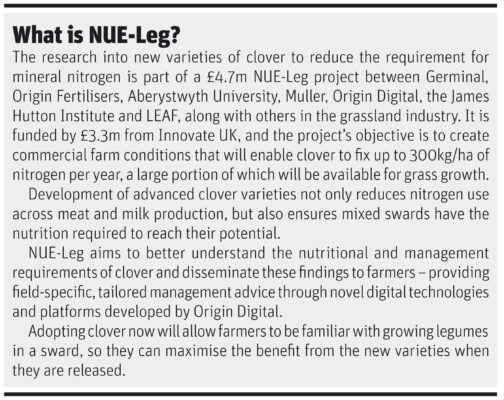
Reducing feed costs, lowering fertiliser requirements through fixing atmospheric nitrogen, and improving forage digestibility can all be achieved through adding clover to swards. And a new £4.7m four-year research project is helping farmers to increase the value of clover in grassland swards.
NUE-Leg seeks to develop modern clovers with increased performance and efficiency. It is made up of a consortium from industry and academia, and is part-funded by Innovate UK through Defra.
The objective is to increase atmospheric nitrogen-fixation to meet grassland requirements, which should improve dairy farmers’ profitability and significantly reduce greenhouse gas and ammonia emissions, as well as nitrate leaching to water.
Of the 4m ha of managed grassland in England, only a small proportion is being actively managed with clover to reduce mineral nitrogen inputs. Clover may be present in as much as 50% of UK swards, however, the potential and output of these crops will diminish through management practices and competition from vigorous grass varieties and weeds.
Reduce use of mineral nitrogen
Peter Scott, Technical Director at Origin Fertilisers, which is one of the project’s key partners, says the primary aim is to significantly reduce the use of mineral nitrogen in grasslands. But there is a difference between nitrogen and nutrition; swards will still need nutrition even if nitrogen is supplied by new clover varieties.
“Ryegrass swards requiring high nitrogen inputs to achieve high yields could significantly benefit from the development of new clover varieties within the NUE-Leg project,” he says.
“These legumes will offer performance and persistency and the chance to significantly reduce nitrogen inputs. Furthermore, introducing prescription nutrition programmes to cater for a range of soil and crop requirements will help maximise the benefits of clover.
“Within the project, our role as the sole fertiliser business is to identify the optimum nutrient profiles for these new legumes, to provide the balance between optimised crop growth, livestock production and environmental enhancement. We will use the information and data learnt in the project to help dairy farmers manage clovers to maximise performance.”
Clover fixes atmospheric nitrogen to the soil through rhizobia bacteria within root nodules. It is becoming a popular addition to swards, as it not only fixes nitrogen for its own use but reduces the nitrogen demand for companion grasses.
Scavenging nutrients
Improvements to soil structure and drainage capacity are also possible due to clover having deeper tap roots than other species. When grown alongside shallow rooting grasses, clover can reach nutrients from deeper in the soil profile, helping to access more of the nutrition and assisting water filtration during periods of heavy rain.
Clover’s nutritional feed value is also of key importance to dairy farmers. “Clover is highly digestible for livestock, as there is a high percentage of leaf area to fibre, while it is also high in protein and mineral content,” explains Peter. “By maximising the clover in grassland, dairy farmers can potentially reduce bought-in supplementary feed.”
The aim of NUE-Leg is that the modern clover varieties developed through the project will maintain a minimum of 30% clover cover in a sward. This helps to supply the companion grasses with their complete nitrogen (N) requirement.

Technical Director, Peter Scott
“Clover can potentially fix up to 300kg/ha N per annum, if we can achieve 60% cover in a sward and manage it appropriately,” notes Peter. “Coupled to this, Origin is working on prescription nutrition programmes designed to optimise nitrogen fixation and help farmers realise
the benefits.”
“Clover can potentially fix 300kg/ha N per annum.”
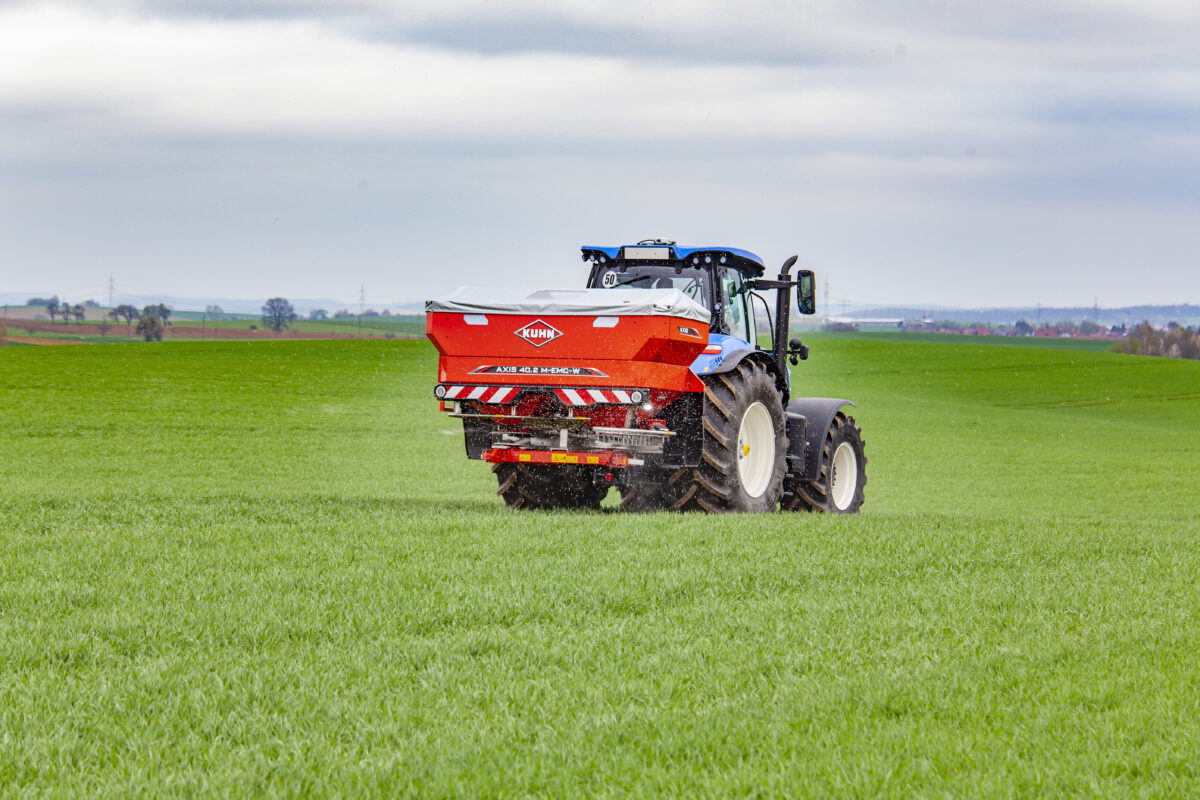
One of the key challenges in maximising the benefits of clover in a ryegrass sward is balancing the specific nutritional requirements of legumes with those of grass. Although established clover doesn’t require bagged nitrogen, that doesn’t mean the fertiliser spreader can be put back in the shed. Greater understanding of the nutritional requirements for each sward is an important factor, which will vary depending on soil type and the proportion of clovers within the pasture.
A better understanding is also needed of the differences in nutrient requirements for the establishment phase of clover and the maintenance and persistence of existing crops. A large part of the NUE-Leg project will focus on identifying the correct nutritional inputs for different clover species, at varying growth stages, within grass swards.
Establishment phase
“Clover, particularly white clover, takes several months from sowing before it starts to fix N, and it requires typically 40-50kg/ha N to see it through this establishment phase,” says Peter. “Other key nutrients, including phosphate, potassium and sulphur, perform the same roles in legumes as they do in grass, albeit greater understanding is needed to identify the optimum amounts and timings in relation to crop requirements.”
Clover is responsive to a wide range of secondary and micro-nutrients, including calcium, molybdenum, cobalt, iron, manganese and copper; some of which are involved in root nodulation and nitrogen fixation. Origin will be trialling a novel concept using metallo-catalysts within the NUE-Leg project, specifically aimed at maximising nitrogen fixation by clovers and other legumes.
“As with grass, there are a lot of important nutrient interactions within legumes which affect dry matter yield and forage quality,” notes Peter. “Mineral ratios are therefore important indicators of nutrient requirements and can be assessed through broad-spectrum soil and forage analyses, which will be used to develop balanced nutrient programmes.”
Targeted, prescription nutrition will play an important role in optimising the potential agronomic, economic and environmental benefits of the new legumes being developed.