
By Chris Walkland
Any ardent listeners to the Kite podcast over the past few weeks will know that my market reports haven’t exactly been cheery. Prices slid throughout late June and July, as a very quiet market took its toll on sentiment. But at the end of July there were some tentative reasons to be (more) cheerful, if not yet particularly optimistic.
The first reason to be cheerful relates to retail dairy prices. They continue to decline from their peaks, with the latest ONS data showing further price drops for butter, milk and cheese. Only yoghurt and ‘other milk products’ continue to increase. Data from a price comparison website also echoes the declining trend among most products and brands – milk, cream and butter are all sliding, while cheddar and yoghurt are still on the up.
On the brand front, Lurpak, Anchor and Country Life are down, as is Pilgrims Choice on cheese. Cathedral City isn’t, though. Cravendale is also dropping. All of this is resulting in some brand holders believing that the tide is now turning, and their brands will be in growth before long, which I touched on in my comment piece in the last issue.
Markets and demand
It sounds bad, falling prices, but in a market dominated by a lack of demand, if dairy prices come down, then this may stimulate greater buying on the domestic market. Against that, though, the boiling hot weather across Europe in recent weeks is not going to do anything for demand there (and nor supply).
Pity the people, the farmers, and, yes, the cows who have had to battle with all that. The school holidays also don’t help demand.
According to Australian market analyst Freshagenda there are also some (modest) positives on the global trade front. China’s powder imports are better than they were, and Freshagenda calculates that total global trade in May rose over 9% in milk solids terms compared to last May. Global trade fell 1.8% over the 12 months to May, and in the six months to May trade was down 0.5%.
Its three-month rolling total for trade is in positive territory for the first time in a year. It’s progress, but only a five out of 10 on a good news scale. Still, it’s better than a one.
Meanwhile, the markets in the UK and Europe remain very quiet, which has led to declining sentiment and thus prices. But the end of July brought some upward price movements on a few commodities, potentially indicating that traders drove the prices too low. The futures prices also turned positive after five weeks of declines, which rekindled the view among some traders that Q4 prices will take a step up.
Gloomy narrative
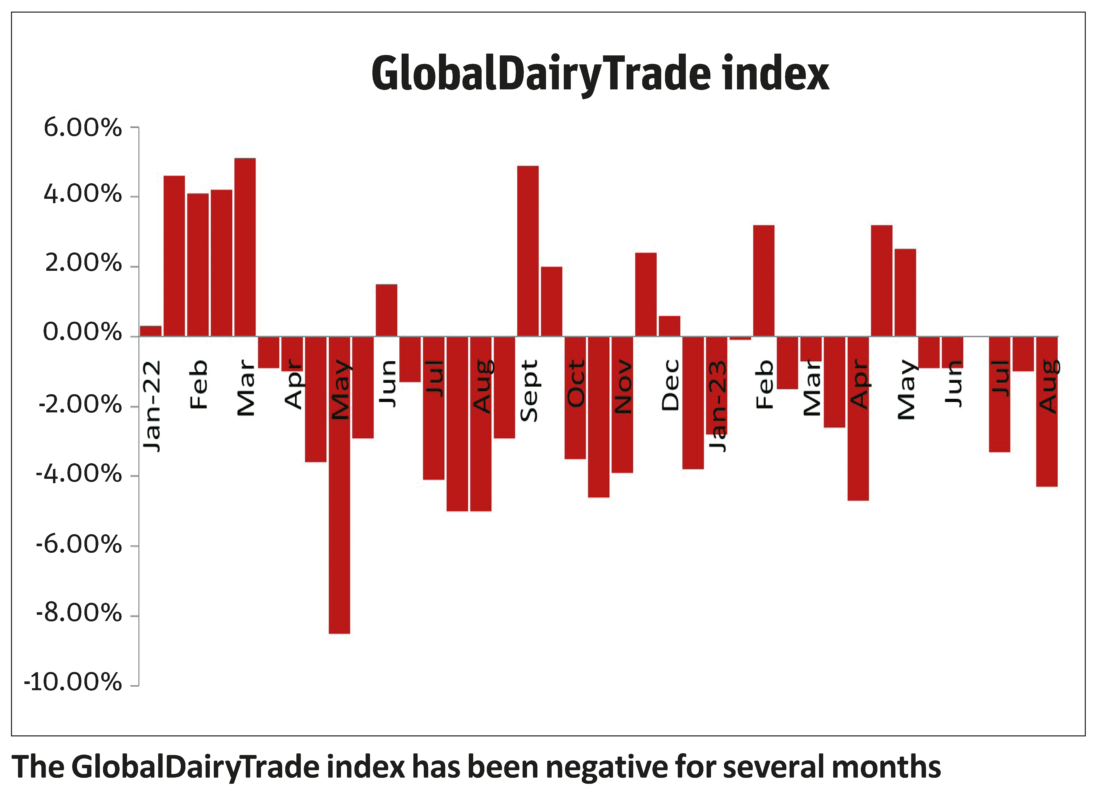
That view had been waning – the GlobalDairyTrade (GDT), the futures, other forward prices and the general gloomy narrative had blurred the horizon that far out. However, the hope was that the futures lift might act as a break in the clouds. A positive uplift on the GDT would also help clear them significantly.
But there’s all-round negativity on the platform, and this might not lift until those global trade figures, particularly with China, lift markedly rather than (very) modestly.
And the first auction in August was a shocker – if sellers had been encouraged by a modest increase in the New Zealand (and EU) futures in the run-up to the auction then they will have been taken aback by the scale of the drop – whole milk powder (WMP) was down a whopping 8% to $2,864/t (£2,255/t). The price hasn’t dropped below $3,000/t (£2,362/t) since November 2020.
Skimmed milk powder (SMP) dropped below the $2,500/t (£1,968/t) threshold for the first time since May of that year, while the overall index stopped at $3,100/t (£2,441/t) – the lowest since September 2020. If anything put a marker down as to just how bad the markets are, then this auction did it. At the time of writing, butter and SMP were at very low prices, with butter at £3,700/t and SMP at £1,900/t. They convert to a milk price well below 30ppl.
AHDB’s gross figure for July was 29.66ppl, in fact, which is down 3p on June. It is the first time the price has dropped below 30p since December 2020. After an allowance for transport, a margin and supply chain costs, the farmgate equivalent is going to be around 26ppl!
Cheese is better, but not significantly so. The spot price of mild cheddar is still falling, and cheesemakers face real challenges and risk on stock values and costs, and interest rates. There are some very cheap mild cheddar parcels knocking around, apparently, and the spot price has fallen again, to £3,400/t.
Cheese returns
So that’s down £200 in a month or so. If you supply a cheesemaker and you want to know what that means for you, then the returns from that are going to be over 30ppl. Just not much over it.
AHDB’s gross milk for cheese value equivalent (MCVE) price for July is 35.9ppl, which equates to a farmgate price of 31–32ppl. Mozzarella has also slipped again after putting on a half decent rise in June. It’s back at £2,850/t again. All of this means that the further milk price cuts we have seen from some processors for September are probably inevitable, I’m afraid, although some like Arla did hold – albeit at a not exactly spectacular price. Currently, the average non-aligned price for August is just over 35ppl, which represents a 26% decline since January.
Some processors have cut their prices by over 30% since then. Commodities have to rise markedly in order to increase the milk price to a level required to close the gap on costs. There is nothing on the horizon to suggest this is going to happen.
The timescale also does not bode well for increases. Even if prices rise in Q4 (a touch, and this will be on the most optimistic outlook) they don’t normally increase markedly in Q1, as all eyes then tend to be on the flush. There are more downward price moves than upward ones in Q4 – in fact if we exclude the extraordinary year of 2022, there have been 73 price increases in Q1 across around 20 processors since 2015.
Of those, 33 of them were in two months in 2017, which was another extraordinary quarter.
Outside of these, there have been only 40 increases. In contrast, there have been 185 negative price moves in Q1. This doesn’t mean increases won’t happen. They might. What drove them in 2022 was the crash in milk volumes that started in June 2021, and which didn’t turn positive until September 2022. We need the same now to fuel Q1 2024 price increase.
But despite some processors saying supplies are 3-4% down on where they expected to be, it’s not the same for the country as a whole, with production up just under 1% on last year, and down about the same compared to two years ago. It’s not nearly enough to turn the market given the demand I talked about at the start.
That said, though, we also need EU volumes to drop as well as UK ones, but the latest assessment from the EU is that volumes will only be down 0.2% in 2023. Again, a level that isn’t going to change the dial much at all!