
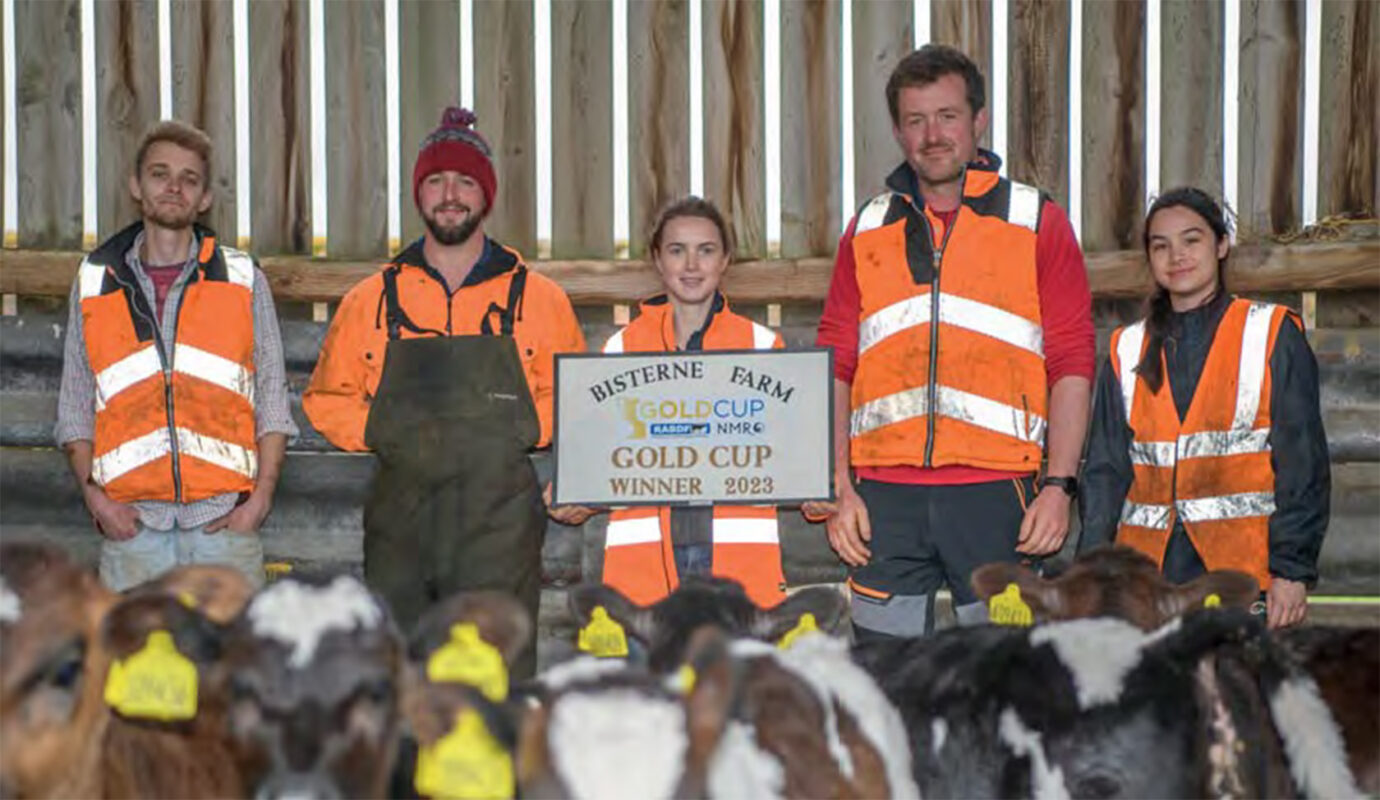
The RABDF / NMR Gold Cup is the most prestigious award in the British dairy sector – attracting entries from some of the best farmers throughout the country. Picking up the trophy this year is Bisterne Farms in Hampshire. Olivia Cooper pays them a visit.
The first thing that strikes one upon arrival at Bisterne Farms is that this is a team affair. Immediately welcoming and open, they sit me down with a cup of coffee as they settle down or breakfast – something they do together every day. “That’s really important,” says Farm Manager George Brown. “We also have weekly team meetings and everyone has their areas that they focus on.”
The team comprises James Dunning, Charlotte Lawder, Oliver Mears and Adam Reddish, who are all full-time, and Rowan Hewlitt and Brandon Lynch, who are part-time. There are usually some vet or agricultural students on-site as well – today it’s Hayley Shone who is being shown the ropes. “It wasn’t that long ago that I was on a placement and didn’t know anything,” says George. “It’s very important to give younger people a go – it’s about climbing the career ladder but not pulling it up after you.”
And there’s no doubt that this is a business set-up. Estate owner Hallam Mills has other business interests, but wanted to keep the farm running, so five years ago Tony Evans at Anderson Consulting suggested a contract farming arrangement. George was the chosen candidate, and the partnership has been a great success. “You couldn’t ask for a better person to work with,” says George. “Hallam is fully involved with the strategic direction of the business and will get stuck in if needed.”
Hallam provides the fixed infrastructure and George the power, labour, machinery and other inputs. George owns one-third of the cows and gets a contractor’s fee to cover operational costs. All the capital gets paid a return, and then surplus profits are split between the two. “For me, it was a good way to be involved in a business that’s a lot bigger than I could have made myself, and for Hallam it enables a motivated person to take over the running of the business.”
Split block-calving
Although the dairy was built in 2001, the design was excellent, which means it’s very easy to run and kind on the cows. And George likes to keep the system simple – even though at first glance split block-calving might sound unnecessarily complicated.
“Four or five years ago, we had 500 spring-calvers, but this is a very dry farm with gravelly, free-draining soil,” he explains. “If we don’t get rain for two weeks we really struggle with grass drying up, and end up feeding over the summer. So we decided to take the load off the grazing platform by split calving.”
In an ideal world, George would like to calve all the cows in the autumn, but the infrastructure isn’t there, and the investment would be hard to justify. “We can only house 400 cows – and split calving takes out the peaks and troughs, which is useful with an employed team.”
A third of the 600 Kiwi cross (New Zealand Friesian x Jersey) cows calve in the spring, with the remainder in the autumn, and the system for both is the same, for maximum simplicity.
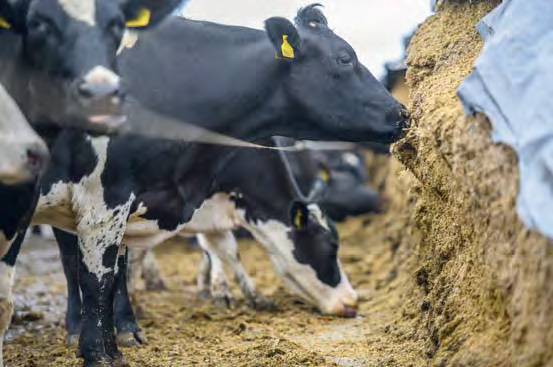
The autumn cows calve inside from August 1 for six weeks, are grazed in August, housed overnight in September, and then fully housed from October to January. They are served from November 5 for six weeks, and then start grazing by day in February before full turnout from mid-April. “They dry off in June and then are housed for the transition period,” says George.
The spring herd calve indoors from February 1 for six weeks, and are grazed by night from February before full turnout in mid-April. “We run out of space in the cubicle shed, which is why one herd grazes at night and the other during the day.” The spring cows are served in May / June, dry off in December and outwinter on fodder beet before coming in to calve.
“We have a dedicated calving shed on straw, and feed bales of hay from the meadows,” explains George. Calves are taken straight off the cows, and given 10% of their bodyweight in cows’ colostrum. They’re kept in groups of 13, with heifers then moving onto milk powder, and beef calves onto whole milk.
The beef calves are sold at three weeks, mostly privately, and the team take great care to optimise their health and growth. “We rear 400 beef calves a year and there’s a big difference in price between good and poor calves, so we use good semen and pay attention to their management.” George only keeps replacements from the autumn calvers, breeding the spring calvers to beef semen. “It’s just simpler – otherwise we’d end up with four groups of youngstock.”
Improvements in calf health

The heifer calves get milk powder twice a day for four weeks before moving onto 1.1kg of powder once a day for another four weeks. “They wean at eight weeks having eaten 50kg of milk powder,” says George. “We used to feed less of a poorer quality powder and struggled with calf health. The solution has been to give them more energy and more powder – and it’s made a monstrous difference.”
The plan is to have all calves weaned by the time artificial insemination of the cows starts, and the calves are fed silage and cake over the winter while housed. “They’re turned out in March having eaten 500kg of an 18% rearer cake.” Once at grass all supplementation ends.
George synchronises the heifers and puts 65-70% of them to sexed dairy semen, with the remainder going to conventional – although once his semen stock is used up he’s likely to move to all sexed. All heifers calve in the autumn block, at two years old, and George selects breeding stock based on good udders, capacity and attachment, with high milk solids. “Most of our culls are due to udders or fertility. We’re asking for reasonable production from them, so we need good udders.”
Breeding preferences
The cows are heat-detected using tail paint and scratch cards, and about two-thirds of them go to sexed semen in the first three weeks of the autumn. The rest have Blue and Hereford semen for three weeks, then Blue and Angus for the second three weeks.
“I much prefer the Angus calves but they look like Jersey crosses and we don’t want to accidentally keep Angus heifers!” A Hereford stock bull sweeps up, and any empty cows roll to the spring herd.
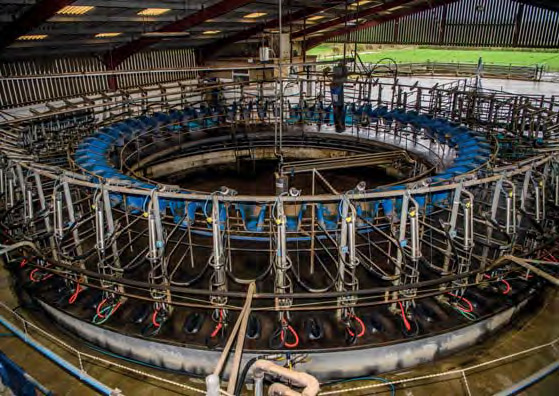
The cows are milked twice a day through the 50-point rotary parlour, at 5.30am and 2.30pm, with the whole process including washdown taking about four hours in the morning and three in the afternoon. They’re yielding just over 6,000 litres at 5% fat and 4% protein, producing 524kg of milk solids. “Last August we peaked at 560kg of milk solids on a rolling basis,” says George.
Milk is sold to Arla on a Care contract, and the herd is averaging 3,500 litres from forage. “That’s down slightly as the silage last year wasn’t as good quality.” The cows also get cake in the parlour, and there’s only 20-30kg difference in milk solids between the autumn and spring calvers. “The autumn calvers eat more cake and produce more solids.”
When it comes to forage production, the 1,620-ha estate comprises about a third arable, a third woodland, and a third dairy. It has 509ha of grass, 20ha of fodder beet, and 50-70ha of maize. Within that, 200ha of grass is in a Site of Special Scientific Interest, so is managed for wildlife, while the milking platform extends to 180ha.
“We try to reseed 10% a year, although over the past five years everything has at least been stitched in,” says George. The 70ha of red clover is rotated around the arable land every four years.
All land work is carried out by contractors, with first cut taken at the end of April, second cut a month later, third cut in July, a fourth in August and the fifth in early October. “The first and second cut go into the clamps, and everything after that is baled.”
When housed, the cows self-feed from the silage clamps of grass, maize and red clover silage. On average the autumn-calving milking cows have 20-22kg dry matter intake per day including 6kg of cake, 1.5kg of rapemeal and 15kg of grass and maize silage in a 50:50 mix. “It’s up to them what they eat – they will take what they need,” explains George. “The hardest bit is maximising utilisation while also making sure the cows are fully fed.”
Grazing cows are rotated onto fresh pasture after each milking, with a 20-day rotation. The grass gets 30kg/ha of nitrogen in March, April, May and June – then none over the summer when it burns up – followed by another 30kg in September. “Any surplus is taken for silage, and anything that’s looking a bit scruffy will be grazed by dry cows,” says George.
Quality health and wellbeing
When it comes to cow health and welfare, the well-designed set-up and robust cows mean there are very few problems to tackle. The herd is mobility scored quarterly, with 2.5% of the herd scoring a two or three, and they’re foot trimmed at drying off if they need it. “We don’t footbath, and digital dermatitis isn’t an issue – we’ve had two cases in the past year.” The only issue in the past year has been a bit of white line disease, as the cow tracks suffered in the wet weather, leading to some stone damage.
Rubber matting at the parlour exit, tarmac at the self-feed clamps, long feed windows and patient moving of cows all contribute to this good foot health. “The cows bring themselves in – we never have to follow them, and have never culled for lameness,” says George.
When youngstock are turned out they get a fly tag and a long-acting wormer – in-calf heifers outwinter on fodder beet before being brought into the cubicle shed to learn how to self-feed. The herd is screened for bovine viral diarrhoea, leptospirosis, infectious bovine rhinotracheitis and Johne’s. “We’re a closed herd apart from buying three Hereford stock bulls every other year.”
Being on the edge of the New Forest, there is a lot of wildlife in the area, so George fences off badger setts and tries to keep deer away. “Deer are a big challenge – so we don’t feed anything at grass.” The farm is in a TB edge area, and the last breakdown was in 2016 from a purchased bull. “Buying in bulls is our main risk.”
Stocking pressure
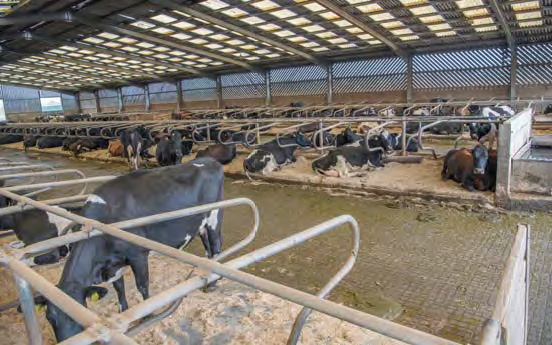
Other health challenges are minimal: Mastitis coincides with calving and autumn housing, when the stocking pressure in the shed is at its highest, but the 12-month average mastitis rate is just 18 per 100 cows. Cubicles are bedded with sawdust and lime.
Antibiotic use is at 7.03mg/kg population corrected unit, with critical antibiotic use at zero. “Our mortality rate over 12 months is 1.4% and our vet spend per cow in 2023 was £24.18 versus a practice average of £64.40,” says George. “We don’t vaccinate, we have no fertility work and no calving issues; it makes for a big saving.”
Future proofing the farm
The team have also been taking steps to future-proof the farm – they’ve just secured planning permission for a new slurry tower and a cover for the existing tower, thanks to some rant funding. “Once that’s done we’ll be set up for the next 20 years, as we’ll have six to seven months’ storage,” explains George.
Slurry is applied using a dribble bar, and drinking water comes from a recently-drilled borehole.
“Investment for compliance is a huge hurdle for the industry, especially when set against the lack of profitability over the past 20 years, and high interest rates,” he admits.
Weather extremes
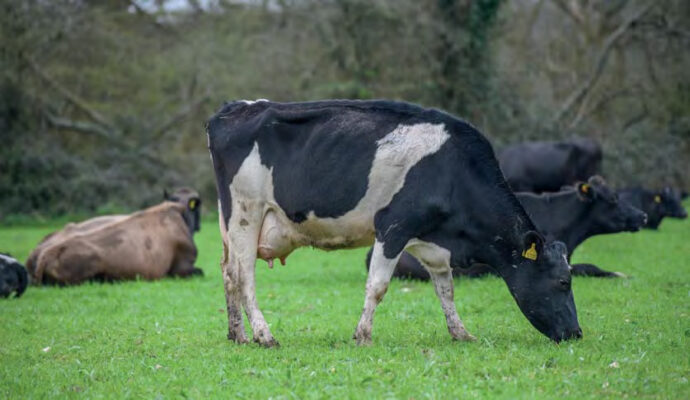
The increasing weather extremes are also a challenge, with hot, dry summers and wetter winters – which is why he has already split the cows into spring and autumn calving blocks. “And if we’re grazing cows further afield during hot periods then we’ll graze at night, so they don’t have to walk far in the day.”
Carbon neutrality is a universal industry target, and George is working towards that by removing soya from the diet, reducing fertiliser use, and increasing clover use in grass leys. “We’re also breeding more efficient cows – there are a lot of opportunities with genomics,” he notes. “It’s been very difficult with a crossbred herd, but I think that will change quickly.”
Labour is another issue, but not one which Bisterne Farms is struggling with. “We have a great team – and I think our decent set-up and staff rota helps to attract and keep good staff,” says George. Staff work 45 hours a week, get three days off per fortnight, and 28 days holiday per year.
“The image of the industry is atrocious for attracting new entrants, and for Hallam public engagement is really important.” The whole estate is in Countryside Stewardship, and is now layering in Sustainable Farming Incentive options – and it takes part in Open Farm Sunday every year. “In 2022 we had 4,000 visitors, and last year we had 1,600 despite the rain,” George points out.
“We do a lot of public engagement, with ex-offenders, charities, young farmers, universities and Scouts. We’re proud of what we do here, and we can’t whinge about the public not knowing about farming if we don’t open our doors.”
And the farm will most certainly be opening its doors on May 22, when it hosts the Gold Cup Open Day. Winning is something that’s only just sinking in for this young and humble team of people. “It’s fantastic for the estate owner, and really great for the team,” notes George. “And it’s wonderful to celebrate that good story for the industry.”