Steve and Ruth Ashley credit farm success to getting heifers off to the best start and making
good quality forage
Excellent heifer performance on a Shropshire dairy farm starts with good dry cow nutrition and calf management. Rhian Price reports on how success has been achieved.
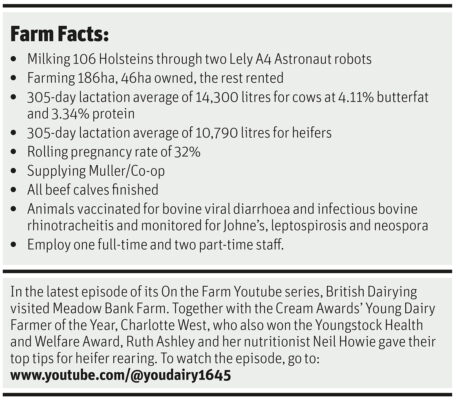
Achieving growth rates of 0.9kg/day up to bulling at 12 months with modest concentrate inputs is no mean feat. Yet heifers at Meadow Bank Farm, Shrewsbury, are hitting this while only being fed forage and a small amount of concentrate (1-2kg) after weaning.
Once heifers reach 11 months, they are on silage only until they enter the pre-calving group around 22 months. Youngstock performance is uncompromised – currently, heifers are averaging 10,790 litres in their first 305-day lactation and the average age of first calving is 22-23 months.
Husband and wife Steve and Ruth Ashley credit this success to getting heifers off to the best start and making good-quality forage. The duo milk 105 Holsteins through two Lely A4 Astronaut robots and are achieving envious yields of 14,300 litres at 4.11% butterfat and 3.34% protein. The cows have a 12-month rolling pregnancy rate of 32%.
It is unsurprising that the couple was highly commended in the youngstock health and welfare category as well as being commended in the High-Performance Dairy Farm at last year’s Cream Awards.
“Bales are not an excuse for poor silage.”
Setting up a heifer calf for a successful lifetime performance starts in the dry cow shed, the couple believes. Together with nutritionist, Neil Howie from Agri-King, they have a shrewd focus on dry cow nutrition. “Good nutrition of dry cows and heifers is paramount, because at that stage, they are feeding the unborn calf and making colostrum,” says Neil. “This is the most important feed the heifer will get in her life.”
Cows and heifers are housed together in a state-of-the-art dry cow shed for 60 days, with the far-off and close-up groups under one roof to reduce stress. Animals have deep sand-bedded cubicles, and the shed has wide passageways and more than 1.2m/cow of feed space.
Far-off dry cows receive haylage, minerals and a small amount of blend. Three weeks before calving, they are moved to the next-door close-up group and receive a full dietary cation-anion balance (DCAB) diet. Heifers receive baled silage and are moved into the close-up group six weeks pre-calving.
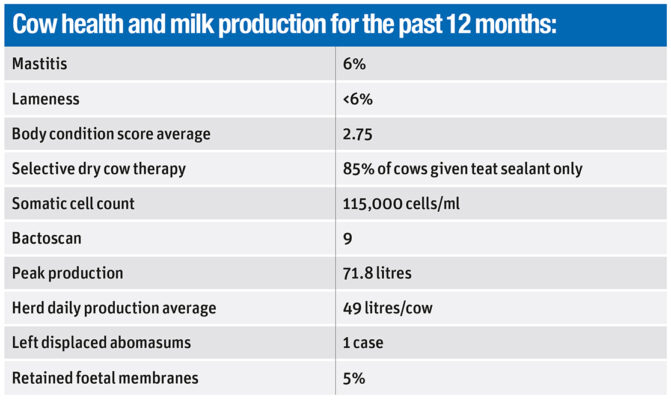
Urine pH is monitored weekly to ascertain if cows are sufficiently metabolically acidified pre-partum to prevent milk fever. The ideal pH range is 6-6.5. The DCAB diet comprises grass silage, maize silage, hay and blend alongside choline and methionine. There have only been two cases of milk fever in the past 12 months (<2%).
“We constantly monitor the ration energy and protein levels to mitigate negative energy balance,” says Neil. “Protein supply is also important for colostrum production.”
The target is for the total ration to supply 14% crude protein (30% bypass protein) and 10-10.5MJ/kg metabolisable energy (ME), he says. At the far end of the shed, there are four straw-bedded calving pens. These have a locking yoke and a calving gate to enable animals to be safely secured.
Accurate warning system
The Ashleys operate just-in-time calving, and to make this as effective as possible, cows are fitted with MooCall sensors as they start to bag up with milk. Wi-fi cameras have also been installed inside the shed to help monitor progress during calving. Ruth says the warning is pretty accurate at predicting calving within an hour, so cows can be moved to straw pens without the move delaying the onset of calving.
Post-calving, fresh cows receive 50 litres of warm water, an energy drink, and a non-steroidal anti-inflammatory (NSAID). They are introduced to the milking ration and are milked immediately with a portable machine, so their calf gets its dam’s own colostrum, providing the colostrum score is high enough (>25%) using a Brix refractometer.
Calves receive colostrum for the first three days of life before moving onto four litres of skimmed milk powder daily alongside fresh clean water, barley straw and starter, both of which are fed ad-lib. Bloods are taken from calves to measure passive transfer and the results act as a precursor for dry cow diets.
Once calves are six weeks old, milk is reduced to three litres fed twice daily to encourage high intakes of starter and prepare calves for weaning. Then, at eight weeks, milk is reduced further, provided they have doubled their birthweight. Finally, it’s cut back to one litre for a week at nine weeks.
Despite the fact that calves are vaccinated at three days old with an intra-nasal vaccine for pneumonia, Ruth admits they were still getting cases, particularly around stressful periods like weaning and disbudding.
“Colostrum is the most important feed the heifer will get in her life.”
For the past year, she has been lung scanning to detect pneumonia alongside Duarté Monteiro from Shropshire Farm Vets. Together, Ruth and Duarté have developed a scanning protocol.
They scan one week after disbudding (four weeks of age), one week after weaning (nine weeks) and before calves move into a post-weaned group to ensure they are healthy. Lung scanning costs £6/scan (£18 for three scans), but Ruth says the information has helped them to halve antibiotic use. Calves are given a score between one and five, with five indicating substantial lung damage.
“We tend to see three as a worst-case scenario but if calves score three, we don’t breed from them because they never fully recover,” Ruth explains.
“The idea is to wean clean because the stress of the group change is enough. If anything scores a two, we will leave it, treat it and scan again in two weeks to ensure the treatment has been effective.”
On the back of the results, they have changed the timing of disbudding. “We used to disbud at five weeks, whereas now we do it at three weeks and lung scan one week later,” says Ruth. “The bigger the gap between disbudding and weaning, the less impact the changes have on the calf and the greater chance of recovery from illness.” The buds are also smaller, which makes it easier, she adds.
“Cows have a 12-month rolling pregnancy rate of 32%.”
Once in the weaned group, heifers receive haylage bales before transitioning to bale silage at six months alongside 1-2kg of concentrate.
At 11 months, concentrate feeding stops and heifers receive an Agrimin bolus alongside a Lely collar to detect heats, ready to start serving from 12 months. On average, maiden heifers are receiving 1.3 straws of semen per conception, with 80% served to
sexed semen. “I did not think it was possible to rear heifers as the Ashleys do with as little concentrate as they feed,” admits Neil. “They are getting heifers pregnant just on forage, a small amount of concentrate and a vitamin bolus.”
However, making good-quality forage is crucial to enable the removal or reduction of concentrate. “We are looking for 16% crude protein as a minimum and an ME of 10.5-11MJ/kg,” says Neil. “We spend much time working out which forage we have available. We don’t judge on cut; we judge on analysis.”
Bales part of the strategy
Currently, heifers are eating fourth-cut bales. “Bales are not an excuse for poor silage,” explains Neil. “They are expensive to make. They are part of the strategy at Meadow Bank, not just a tidy-up. With the growing seasons as they are, later-season grass can be every bit as good as early season.”
Steve operates a multi-cut silage system, carrying out five to six cuts throughout the growing season. In the past two years, an increasing focus has been placed on soil health.
“Good crops grow from healthy soils,” says Steve. “I’m learning a lot about soils. We are carrying out more aeration and sward lifting and trying to plough less.”
He has started introducing clovers when reseeding, and sowing grass after maize to protect the soil. This season they will be using compost on maize fields to boost soil biology. Steve explains: “We are starting small with a homemade Johnson-Su Bioreactor (compost in an intermediate bulk container or IBC) and we will see how that goes, then perhaps move to a larger-scale Bokashi system.”