
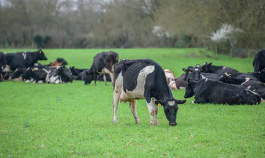
This year the NMR / RABDF Gold Cup Open Day will see Bisterne Farms showcasing how its low-input, grass-based, crossbred herd took the win, highlighting how the team’s focus and performance led to victory. So what can visitors expect from the day?
Bisterne Farms first invested in dairy several years ago, when in the process of amalgamating three smaller herds. “Before transitioning to spring calving we spent a period milking Holstein cross cows, and we have more recently moved to a split block pattern with an autumn bias,” explains Contract Farming Partner George Brown.
“Today we farm 500ha of grassland, with additional land for maize and fodder beet. Some 200ha of grazing is in low-input river meadows, managed predominantly for wildlife, and the entire 1600-ha estate is within various conservation agreements. We cherish how our dairy sits side-by-side with nature, while being a commercial core in our farming operation.
“While there are challenges, it’s an exciting time to be in dairy, and we remain focused on running a profitable business that is committed to meeting consumer and regulatory demands.”
Industry experts
Industry experts from the Andersons Centre, LIC and Synergy Farm Health, who have contributed to the farm’s success, will speak at the event in a series of talk stations situated around the farm. They will explain how George and his ambitious team have focused their attention to detail to enable the herd to produce 3,730 litres of milk from forage, as well as highlighting the finer details when it comes to daily practice, looking at how these decisions have ultimately resulted in the business becoming a ‘premier’ herd.
Sponsor, Virgin Money, has supported and backed George for many years and has watched him successfully grow and expand over time. From the off , when George was still working as a Farm Manager in Cumbria, his future success was clear, says Agricultural Business Manager Justin Ellis.
“For a business like Virgin Money, supporting days like these is paramount, getting the opportunity to celebrate the best in class when it comes to operations on the ground. It’s not only great we are able to celebrate George’s story and success, but it is an excellent opportunity to meet other top-class farmers in the industry.”
When their paths first crossed it was to help George buy his first livestock while working as Farm Manager. From this, George was able to slowly invest in more livestock over time, until he was able to progress and reach his next business target – growth – ultimately farming as he is now at Bisterne.
As well as supporting financially, the relationship is now such that George shares many of his ideas with the bank, which sees them working alongside each other to meet future goals. “If you want to see a first-class dairy business with clarity around both business and dairy farming strategy, this is not a day to be missed”, says Justin. Whilst visiting, it’s worth taking a look at what the business is doing when it comes to calves. While they won’t be housed at the farm on the day, recorded footage demonstrating feeding protocols will be shown, courtesy of event sponsor Bonanza Calf.
Feeding protocols
This will highlight the changes Bisterne Farms has made in terms of milk replacer to ensure calves are receiving maximum levels of utilisable amino acids. The farm now uses Shine Original, which is made with low heat dried skim and buttermilk, allowing the milk proteins to be utilised and slowly digested throughout the day. Low heat dried skim and buttermilk form a clot in the abomasum of the calf in the same way as cows’ milk.
Consistency is key; mixing the milk replacer at the same rate and temperature each day allows the team to follow feeding protocols and adjust the total number of litres given to each pen according to the calves’ age.
“This system encourages concentrate intakes and enables the farm to wean the calves at eight weeks old, or when they are intaking at least 1.25kg/head per day of starter feed,” says Mollie Phipps, Regional Sales Manager at Bonanza Calf. Th e farm also feeds hay made from its meadows alongside concentrate feed, which not only utilises the farm’s resources but encourages rumen development.
“By only feeding one milk feed per day (from 28 days), you are increasing the digestive system’s development by boosting the dry feed and total dry matter intake,” she adds. “Th is has a positive effect on the immune system and helps to eliminate health issues before, during, and after weaning. Because the calves have a more developed rumen at weaning, their post-weaning performance is better, allowing steady growth rates to continue.”
Talk Stations
– repeated at 12:00, 1pm and 2pm
- Grazing genetics and the ideal cow – Sally Pocock, Livestock Improvement Corporation
- Profit drivers in grass-based systems – Piers Badnell, Livestock Improvement Corporation
- What proactive veterinary care looks like for block calving herds – Josh Swain, Veterinary Surgeon and Claire Rudd, Regional Lead at Synergy Farm Health
- The mechanics of a contract farming agreement – Oliver Hall, Partner, the Andersons Centre
Gold Cup Open Day: Wednesday 22 May 2024. Gates open 10:30am. Order your free tickets NOW!