
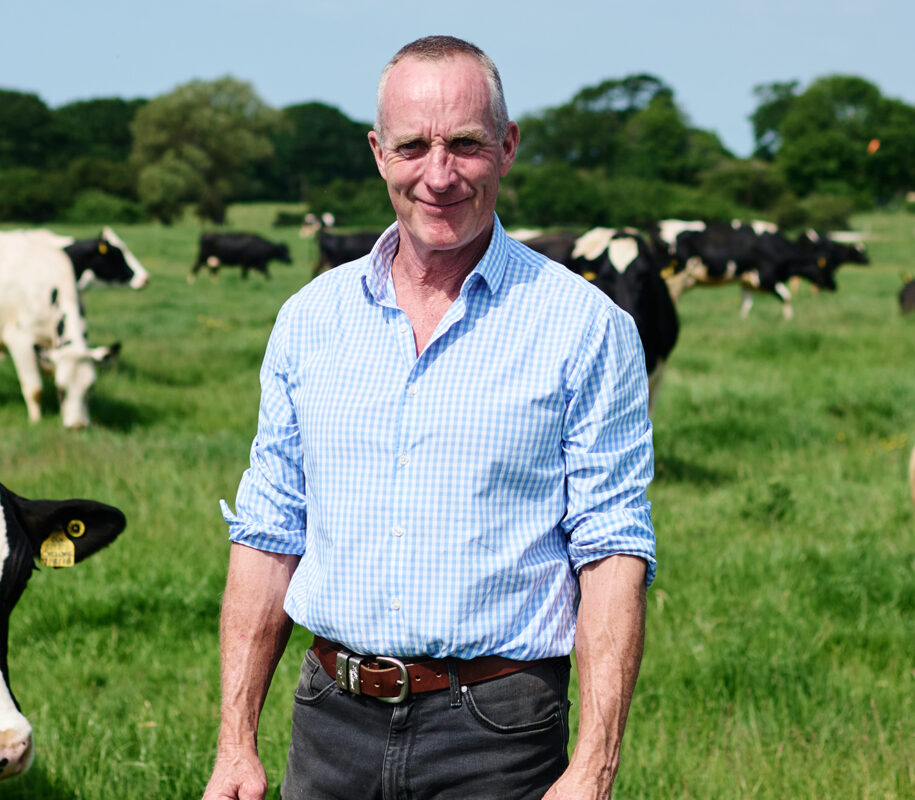
Chris Spiby farms in Sussex and was looking to improve fertiliser efficiency
Identifying new ways to collaborate with its Select Farms to reduce their carbon footprint is an important focus for Marks & Spencer. So, it jumped at the opportunity to trial a new ‘green’ nitrogen fertiliser to cut carbon and significantly boost yields.
With ambitious net zero targets across its supply chain for 2040, M&S is continually looking at new ways to decarbonise. Most recently, these efforts have involved carrying out a series of green fertiliser trials on two milk pool Select Farms to investigate the positive environmental impact that green artificial nitrogen could have in dairy farming systems.
“Artificial nitrogen (N) has an important role to play in dairy systems,” explains Andrew Stilwell, Arable Technical Director at Bartholomews Agri Food, who organised and managed the farm trials.
“But its use has an environmental impact. On the positive side, it helps produce high volumes of better-quality home-grown forage, reducing reliance on purchased concentrates. On the negative, energy is expended to produce the fertiliser, as well as potential nutrient leaching and nitrous oxide emissions when applied on farm.
Solar-produced hydrogen
“That’s why the M&S project results are so exciting. The Fertiberia Impact zero DS+ product being trialled is produced using green hydrogen from solar energy. This dramatically reduces the carbon footprint of its production compared with conventional nitrogen,” he adds.
“The controlled release polymer coating and nitrification inhibitors within the product also aid the slow delivery of nutrients – improving uptake efficiency – as well as reducing leaching.”
The trials took place during last year’s silage season, using an identical 19-treatment strip trial layout on two farms. A range of conventional fertilisers, applied at different rates, were tested alongside the DS+ product from Fertiberia’s Tech Nergetic range.
The trial layout was representative of field conditions and produced hundreds of data points analysed by SAC Consulting. Based on estimated dry matter content, this initial data shows the DS+ product helped achieve direct carbon savings of 93.45kg CO2e/ha (4.71kg CO2e/t dry matter) on farm (analysis excludes carbon associated with the DS+ polymer coating).
Carbon savings
And when additional improvements to grass yields and grass quality were taken into consideration, carbon savings increased to 122.42kg CO2e/ha (6.17kg CO2e/t DM).
“The green fertiliser was applied at a rate of 150kg/ha,” explains Andrew. “Analysis has shown that compared with equivalent conventional nitrogen sulphate (NS) 27:12 fertiliser sown at the same rate, fresh weight grass yields were 31% higher, and double that of control plots with no fertiliser applied.
“Our green fertiliser product range incorporating these unique technologies will continue to progress, helping to improve efficiency and productive potential further, and reduce the carbon footprint associated with fertiliser use across all crops.”
M&S Select farmer and milk pool member Chris Spiby, who milks 700 high-yielding Holstein cows on an all-year-round calving system in Chichester, was one of the dairy farmers who took part in the trial.
“We’re very conscious of the environmental impact of inputs,” explains Chris. “We’re right on the edge of Pagham Harbour Local Nature Reserve, with watercourses, marshland and wading birds neighbouring some of our farmland.
“We’re always looking at ways to use fertiliser as efficiently as possible, reduce potential nitrate leaching and prevent runoff. That’s what made the M&S trial so intriguing.”
Financial implications
Chris is also conscious of the financial implications of using artificial fertiliser, and it was a combination of these two factors that persuaded him to stop artificial N applications on all silage ground last year – apart from land dedicated to the M&S trial.
“We aimed to fuel grass growth by only using slurry,” continues Chris. “We invested in an umbilical tanker system to use our slurry more efficiently, but even so, at the end of the season we saw a 20% decline in grass silage yields. There was a definite drop in crude protein levels too, falling from around 150-160g/kg in 2022 to 81g/kg last year. At the same time, we were applying the DS+ product on the M&S trial plots at a rate of 150kg/ha and even visually you could see the difference. The grass grew well and looked lush, with good regrowth rates between silage cuts despite challenging weather conditions,” he says.
“These two parallel experiences highlighted just how important artificial nitrogen is in our system.
“Clearly, we need to keep investing in artificial nitrogen to support our home-grown forage production and its environmental and fiscal benefits. So, it’s good the trial data indicates these positives can be secured with a lower carbon footprint product.”
“We need to reduce the carbon footprint associated with milk production.”
Although Chris doesn’t view the new fertiliser as a stand-alone solution, he’s confident it will play a useful role in the future.
“Using green fertiliser is just one of the tools we have to achieve carbon reductions, alongside improved feed efficiency, better genetics and feed additives,” he explains. “Animal agriculture is an important part of the food supply chain, but we need to do our bit to help reduce the carbon footprint associated with milk production.”
Another M&S Select farmer near Cirencester, Austin Russell, also took part in the green fertiliser trial last year. “We run a herd of 250 pedigree Holstein cows on around 348ha, milking twice a day and achieving average yields of 11,900 litres,” explains Austin.
“Since I came back to the family farm around 12 years ago, we’ve had a big drive to limit the farm’s environmental impact and produce food more sustainably.
“For example, we’re now direct drilling, and using cover crops on arable land, as well as strip tilling our maize. We’re always looking at new ways to use inputs as efficiently as possible and minimise waste.”
Fuelling performance
Austin takes a multi-cut approach to silage making and has historically used an NS 38:19 fertiliser to help fuel grass performance. “We’d usually apply around 220kg/ha in early March, followed with 400kg/ha after second cut and gradually taper off to 100kg/ha for fourth cut,” explains Austin.
“We find the combination of N and S supports yield and grass protein quality.
“Although we need artificial nitrogen to support our home-grown forage objectives, I was happy to be involved in the trial to see if we could use a greener alternative. The DS+ product had a very positive impact on the grass; it looked healthier, with lower levels of fungal disease, and grew quickly between cuts.
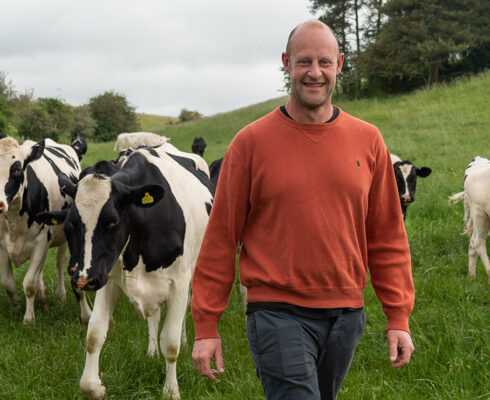 Austin Russell needs fertiliser to boost yields but wants to cut emissions
“The data has since demonstrated the product’s ability to boost grass yield. It would be interesting in future trials to see what levels of production we could achieve with lower application rates. This would enable us to use inputs more efficiently and further reduce our carbon footprint.” Austin now plans to test the product on his arable crops. “M&S has a solid understanding of the challenges we face as dairy producers when trying to reduce our carbon footprint,” he notes.
“This project has been a good example of people coming together from across the supply chain to find solutions to environmental challenges. Hopefully it is just one of the new things I’m able to trial and implement on the farm to reduce our carbon footprint further.”
Use of the green fertiliser is now being expanded across more farms in the M&S milk pool.
“The milk pool has a long track record of adopting innovative solutions to improve sustainability,” says Steve McLean, Head of Agriculture and Fisheries at M&S.
“We’re always looking at new ways to use inputs as efficiently as possible.”
“With bold net zero targets and 72% of M&S Food’s emissions coming from agriculture, it is critical we work with our farmers to deliver meaningful change.
“We believe the use of these fertilisers will enable our farmers to maintain productivity while helping to decarbonise milk production.”