
High input prices are leading to tough decisions surrounding cost control on-farm, but it is important not to scale back your weed control strategy to the detriment of your grassland. British Dairying finds out how to tackle these weeds.
Maximising homegrown forage is more important than ever, so it’s important not to ignore weed control in a bid to cut costs. While it may help in the short-term, it’s likely to cause problems for sward productivity in the future.
“It is vital to control the major problem weeds like docks, thistles, ragwort, buttercup and nettles, as they can quickly dominate a sward, reducing its nutritional value, with potential to cause animal health issues,” says Dave Gurney at Corteva.
Grassland productivity
“Make sure the right plant species dominate without allowing weeds to take over. Even at low populations, weeds pose a threat to grassland productivity. For example, a 10% dock infestation can equate to a 10% reduction in grass dry matter, leaving significantly less grass growing for livestock to consume.”
Weeds also have lower feed value than sown grass species, so their presence in silage fields in particular can cause nutritional shortfall. This may need to be supplemented by other, more expensive, bought-in feed, he explains.
Controlling weeds when they are young in newly-established grassland remains the most effective approach, and requires less herbicide than controlling them later when they have become established.”
However, it remains vital to control them at this later stage, too, as this is when they have the most impact on yield and quality.
“The economic conditions are tough at present, so ensuring you gain the most from grazed grass and winter forage is imperative,” notes Dave. “Carefully planning your weed control in the summer months could save you money in the long run.
“Taking the time to plan a spray in your grassland is vital to its success. A well-timed spray, using the right product, can significantly reduce the weed burden and encourage grass growth, as well as minimise the risk and cost of having to spray again.”
Effective dock control
Left uncontrolled, docks can out-compete grass species for valuable nutrients, especially costly nitrogen.Docks carry little nutritional value for livestock but are prolific and fast growing, with deep taproots giving the ability to withstand grazing
and cutting.
“Any level of dock infestation reduces grass yield,” says Dave. “A practical way to calculate the impact on grass dry matter (DM) is to pace out a 5x7m area, ideally in five positions in the field in the shape of a W.” Counting the number of docks in each area, and then dividing the total by the number of plots will give the percent DM loss being caused by the docks. So, an average of 20 docks across five plots equates to 20% lost grass DM yield.
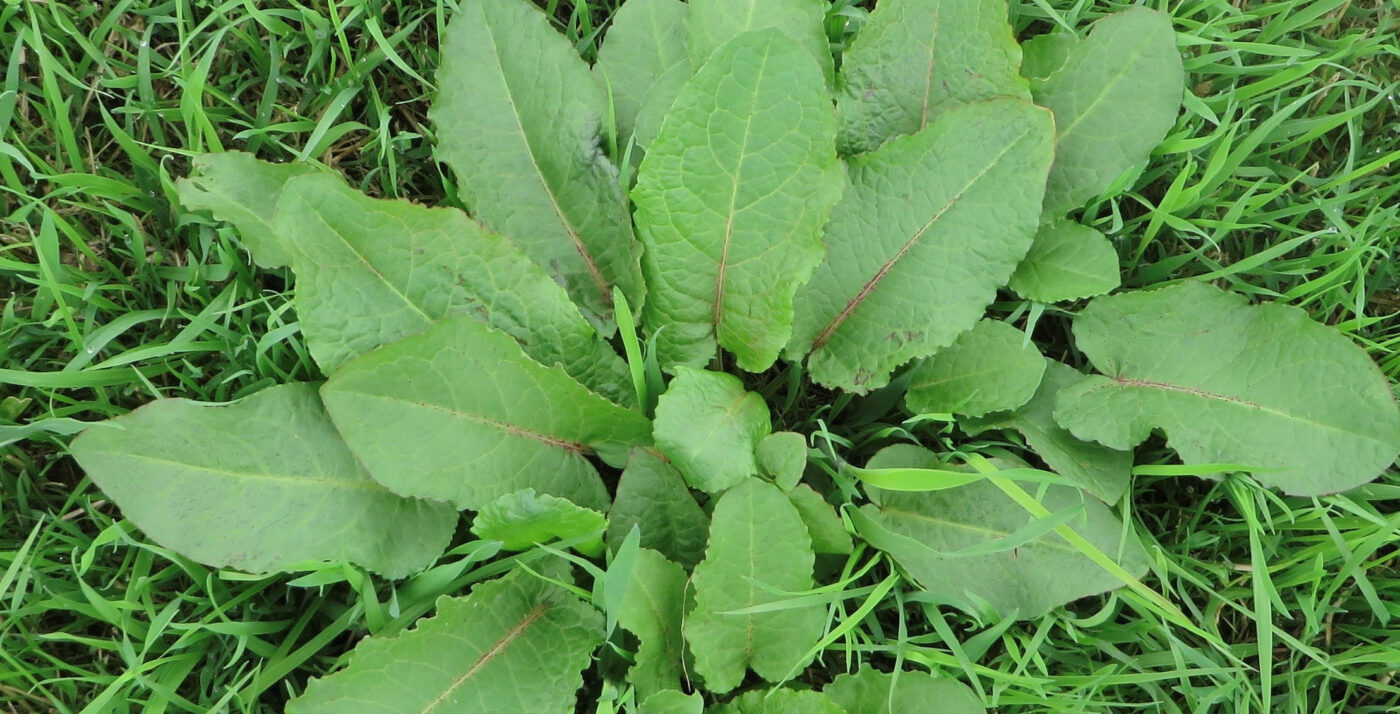
The two main types of docks in grassland are broad-leaved and curled dock. Curled dock is the most difficult of the two to control. It is thought the most likely reason for this is that curled dock has a very erect growth habit with narrower leaves, compared to the broad-leaved species, making it more difficult to target with a spray. Maintaining recommended water volumes is important to
minimise this effect.
 Creeping and spear thistle are increasingly problematic across the UK
Using herbicides
“Farmers need to maximise benefits to protect investment in chemicals, but also future productivity,” says Dave. “It is too late for effective treatment when docks are flowering.
“The weed becomes a problem as soon as it is visible and needs to be controlled at its optimum size. Timing and weed health are everything. The rosette needs to be 15 to 25cm across. In grazing pastures, dock rosettes larger than a dinner plate are best topped before spraying.
“We want the leaf to absorb the chemical and to translocate it to the root, as it’s the most difficult and important part to kill,” he explains. “If the plant has already flowered, the chemical will not move into the root system effectively and this will result in ineffective kill, meaning the plants will recover quite quickly.”
Apply your chosen herbicide when docks are growing actively with a good clean leaf, minimal ramularia and no significant dock beetle damage pre-flowering, advises Dave.
“A good time to spray at this time of year is two to three weeks after cutting grass for either silage, hay or haylage, catching the recovering docks at a critical time when they have fresh, healthy leaves and are of a size that sufficient chemical can then be absorbed and translocated.
“For good dock control, choose a translocated herbicide, like Doxstar Pro, which when applied at two litres/ha in 300-400 litres/ha of water will kill down to the roots. It is not safe to clover, so should only be used on clover-containing swards where it is intended to kill the clover.”
To allow for optimum translocation, silage can be cut 28 days after spraying and stock can return to graze after just seven days.
Tackling thistles
Creeping and spear thistle seem to be an increasing problem across grassland areas of the UK.
These weeds can restrict a field’s grazing area, denying livestock energy and protein.
Creeping thistle, a perennial plant, spreads underground horizontally by 1-2m per year via its root system, producing many offshoots. These roots are also very brittle and easily break into fragments which grow into new plants. Coupled with the rate of root spread, this makes them hard to control.
“The best time for thistle control is at the rosette stage.”
On the other hand, spear thistle, a biennial plant, produce up to 8,000 seeds which can remain viable for three years.
Farmers can achieve a better return on investment if these weeds are targeted at right time, says Dave. “The best time for thistle control is at the rosette stage when thistles are actively growing, up to 20-25cm in height, but before flowering.”
As with dock control, it is important to select a product which will kill down to the root and not just kill the top of the plant.
“Thistlex used at one litre/ha in 200-400 litres/ha of water must be applied using a boom sprayer; it is perfect for controlling thistles in grassland grazed by cattle and sheep.”