
In the first of a series of monthly columns, Harper Adams University’s (HAU) Kate Robinson reflects on the past few months since winning the NMR / RABDF Gold Cup.
I can resonate with the words of all the past winners. The past few months have been a mixture of highly elated emotions and a sense of pride from the farm team. To have won the prestigious Gold Cup based upon our debut entry was most unexpected.
Making it to the finals was an amazing achievement for the team; it certainly gave us all a boost. Hand on heart, we all thoroughly enjoyed the judging day; it was a great opportunity for me to step back and watch each person talk passionately about what they do at the dairy and why they do it. I am in awe of what they achieve every week, despite the challenges of operating in a university setting with all the extras we cover.
Over the next 12 months, you will hear from others in the team, sharing their stories and dairy insights. We have the dairy team, including Alice, Becky and Jon.
Youngstock are covered by Carrie, Erin and Josh. The dairy research team (and beef/ sheep technicians) are Emily, James, and Levana. Matt is a bovine breeding specialist. And I must mention Tony, our amazing shepherd who juggles the flock around cattle grazing and forage ground like a game of Twister.
Chris is the crop and farm operations manager working alongside his team: Luke, Sean, Alan and Joe. We also have a great support network with David Howard our nutritionist and Dan Humphries and Dave Gilbert, our farm vets, supported by the Horizon dairy vet team.
Celebrating our win back in February, which feels like yesterday, has led us on an exciting journey filled with press coverage, farm visits, and interviews. Immediately after our victory, we dove back into action with a farmer-led Muller workshop focusing on dry cow management on the farm. Since February, we’ve hosted 21 farm visits, welcoming guests from local colleges, ministerial offices, industry partners, and academics from various institutions. As we bade farewell to students heading home for Easter, we wrapped up the final sessions of the vet school cattle handling practical in early April.
Looking ahead, we are gearing up for the upcoming teaching sessions, including clinical cattle exams scheduled for May, and farm tutorials centred around body condition and locomotion scoring.
Our dedicated dairy research team is currently immersed in preparations for an upcoming study set to kick off in June, all under the guidance of HAU Professor Liam Sinclair.
HAU plays a pivotal role as a partner in the UK dairy carbon network, in collaboration with the AHDB, showcasing our commitment to cutting-edge research and industry partnerships.
On the farm, the grass is slow to get going even after an unusually warm start to the spring, due to a lack of rainfall. As a creature who loves the heat and hates the cold, I will not complain about the warm weather, but I was thinking of doing a rain dance to get the silage fields springing into action!
Chris and his team have applied fertiliser, slurry and manure on forage and arable ground much earlier than anticipated due to the unusually good weather. He is busy getting muck onto maize ground and dusting the forage harvester off ready for first cut silage. The aim is for at least four cuts of grass and lucerne, with haylage baled for youngstock and sheep later in the year.
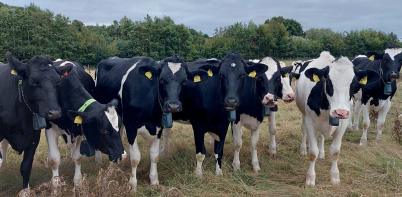
Current growth is between 4,000 and 5,500kg dry matter (DM)/ha, with grazed fields averaging covers of 2,000kg DM/ha. Carrie has turned the in-calf heifers and pre-bulling heifers out onto grass covers and moved the outwintered heifers onto spring grass. She has split the groups up on the species-rich conservation grazing, and some heifers are grazing using No-Fence collars.
This will be our third year using the collars, and I have to say I am a convert after having reservations about them. The data generated is amazing and shows grazing patterns, time spent grazing and preferences to certain grass species. We have given the first vaccination against Bluetongue to all the cattle, and Tony is currently working through the sheep, who luckily only need one injection. We are due for our six-monthly TB test in mid-May, which will take up the best part of a week to complete. It is a week that we all dread, as there is no guarantee of the outcome, even with implementing best practice for farm biosecurity and badger proofing what we can.
Carrie and I attended the panel discussion on TB hosted by Harper-Keele farm animal vet students in February. It was a lively discussion with TB experts Sarah Tomlinson and Dick Sibley and farmers affected by TB. The message was clear that farmers need to work with their vets, policy needs to change as the disease changes, and we need more targeted surveillance. With the increasing incidences of foot-and-mouth disease across mainland Europe, we have implemented stricter biosecurity on the farm. For those of us old enough to remember the last outbreak in the UK, farming faced losses that devastated the livestock industry and heartache for all the people involved. It was a time in history we do not want to repeat.
On a positive note, we have just celebrated winning five awards in the Shropshire NMR herd competition, which included a first for in-calf heifers and a second for large herds.
Alice and Becky were also awarded the Judge’s choice for their enthusiasm and management of the herd, which is a great success to add to their flourishing careers.
We are busy getting ready to welcome you to the Gold Cup Open Day on July 2. Let’s hope the weather plays ball and we have a glorious sunny day; everything is better when the sun shines.