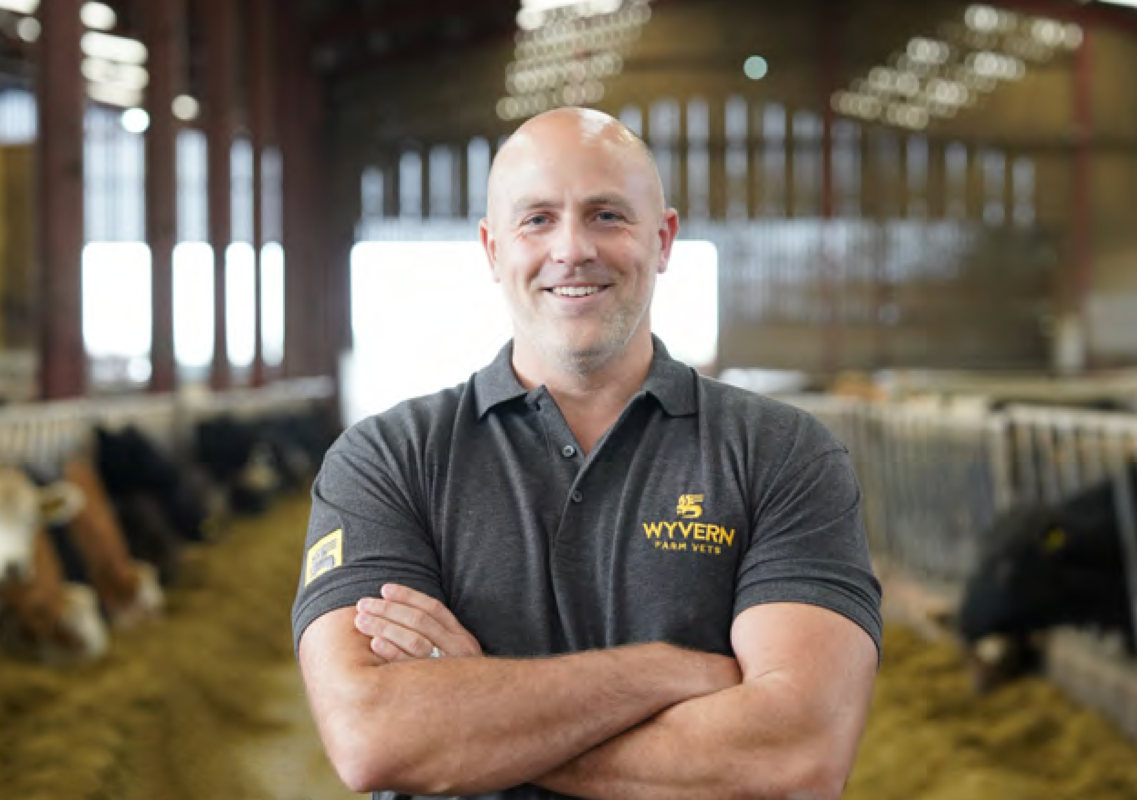
Vet Chris Mangham
“Simplicity really is at the heart of everything we do, from managing cow health to what we feed them and from breeding decisions to grazing management,” says Jamie Pottow from East Farm, Knook near Warminster.
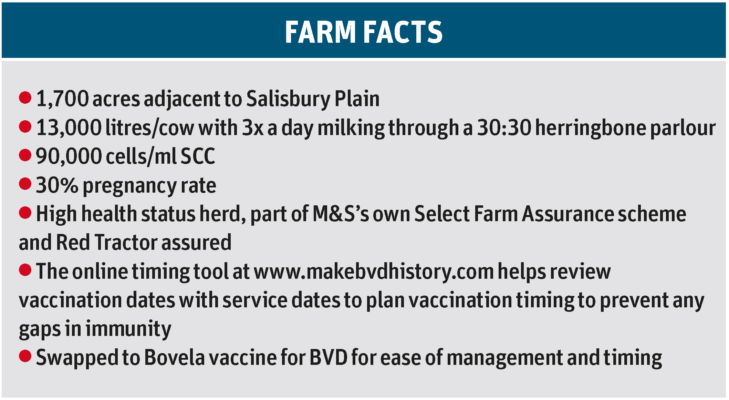
But don’t let this fool you; the 350-strong milking cow herd – Eastknook prefix – is milked three a day with an average yield of 13,000 litres/cow at 4.2% butterfat and is a top performing herd according to GTPI (Genomic Total Performance Index Holstein Association USA’s clas.sification equivalent to the UK’s PLI). Jamie was also the proud recipient of the Holstein UK President’s Medal Award in January 2025.
The 1,700 acre family farm is split into different enterprises with Jamie’s father and two uncles taking responsibility for leading on: arable – dad Robert, the cows – uncle, Richard and all things machin.ery – uncle, Nick. After some time milk.ing a 2000-cow herd in Canada, Jamie returned home in 2021 and now looks after the cows on a day-to-day basis as well as doing the 4.30am morning milk.ing 10 days out of 14.
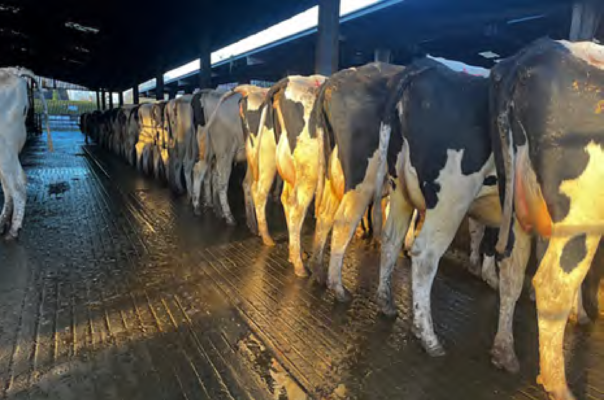
Edging Salisbury Plain, the free-draining farm has 600 acres of ara.ble, while the rest of the land is down to either grass, maize or wheat for the dairy enterprise. “Like most, we try to optimise home-grown forage to control costs and we usually aim for two grass silage cuts for the clamp and up to three baled for the youngstock and dry cows. This year, despite the dry weather, we managed three cuts in the clamp and a final baled grass silage cut in mid-Octo.ber; none of us can remember one that late before!”
“Traits we look for in sires include milk production, fertility, cell count,
strength and legs and feet”
The milking cow ration is 40% grass silage, 60% maize, caustic wheat and ground wheat, both from the home-grown wheat, and rape as the only bought in straight. Minerals and vitamins are also added.
The herd is on an M&S Muller con.tract and has been for five years. Part of this means that anything 90+ days in milk (DIM)must have access to graz.ing for 110 days. When housed, they are in a cubicle shed bedded on sand with auto-scrapers to help ensure high standards of cleanliness.
“Traits we look for in sires include milk production, fertility, cell count, strength and legs and feet,” says Jamie. “The cows are large, strong Holstein cows – not the biggest you’ll see, we don’t need that – with good conformation. Since M&S required the 110-day grazing period in each lactation, we do prioritise hoof traits and management, as there’s obviously more walking. We carry out routine trimming at 100 DIM and 200 days pregnant by an external hoof trim.ming contractor, should there be any lame cows in between, we will step in and trim as necessary.
“You can have the highest yielding, best looking cow in the world, but if she can’t walk to and from the parlour, or out to grass, she’s no use to you,” he adds. “Our cows will typically have four productive lactations in the herd, and part of the reason for this is that lame.ness issues are low.”
Vet Chris Mangham from independ.ent vet practice, Wyvern Farm Vets in Frome has been working with the herd for nearly 18 years, and attends regular weekly visits. “The herd is a well-organ.ised, well-run herd which is evident by its superb performance and the lack of issues around mastitis, fertility, calf and cow health.
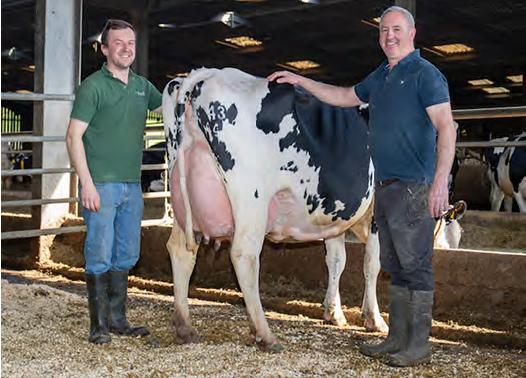 Jamie Pottow and uncle Richard
“Calves are relatively unbothered with the commonly-seen health issues typically affecting them – scour and pneumonia – and Emily, who looks after them, does an excellent job with great attention to detail,” adds Chris.
“Mastitis levels are low with only around 15% of the cows being double-tubed at drying off and cell counts are typically 90,000 cells/ml. Fertility is equally strong with conception rates in excess of 45% and a 30% pregnancy rate. Vaccinations are also given for BVD, IBR and Leptospirosis although, what has been a challenge, has been managing the logistics of that especially for BVD,” Chris explains.
Once born, the dairy replacement calves are housed in hutches until eight weeks of age when they move into larger weaning groups in pens until six months of age. They are then moved to a parcel of land a few miles away which already had a shed on-site. Beef calves are sold to Meadow Quality Calves at under 42 days of age.
”We aim to bring the replacements back to the main farm at 11 months of age when we will put heat detectors on and plan their first vaccination which will be for BVD,” says Jamie. “My uncle and I do all the AI ourselves and I like to see one active heat prior to service. As a year-round calving herd and due to the fact we were bringing a few heifers back over a few days and weeks, as opposed to all at once, we struggled to manage vaccine timings, especially the second dose. If something cropped up, or we had to prioritise a different task in the moment, it was all-to-easy to get to service unsure if everything had received its full primary course and was protected.”
As members of BVDFree when it was up-and-running, the herd has always been clear of BVD previously, tag testing, bulk milk sampling and blood sampling to ensure this was the case.
“As we know the herd is free of the BVD virus, this has now been pared back to tagging and testing everything and swapping to the Bovela vaccine which is easier to manage due to its one-shot primary dose and flexible booster regime plus the fact it delivers 12 months’ protection,” Chris adds.
“Opting to use Bovela also helps with our ethos of keeping things simple when it comes to BVD management,” concludes Jamie. “Coupled with tag and testing, we are confident that we will be able to keep the herd clear of BVD ahead of the next eradication scheme which is due to come in summer 2027.”