
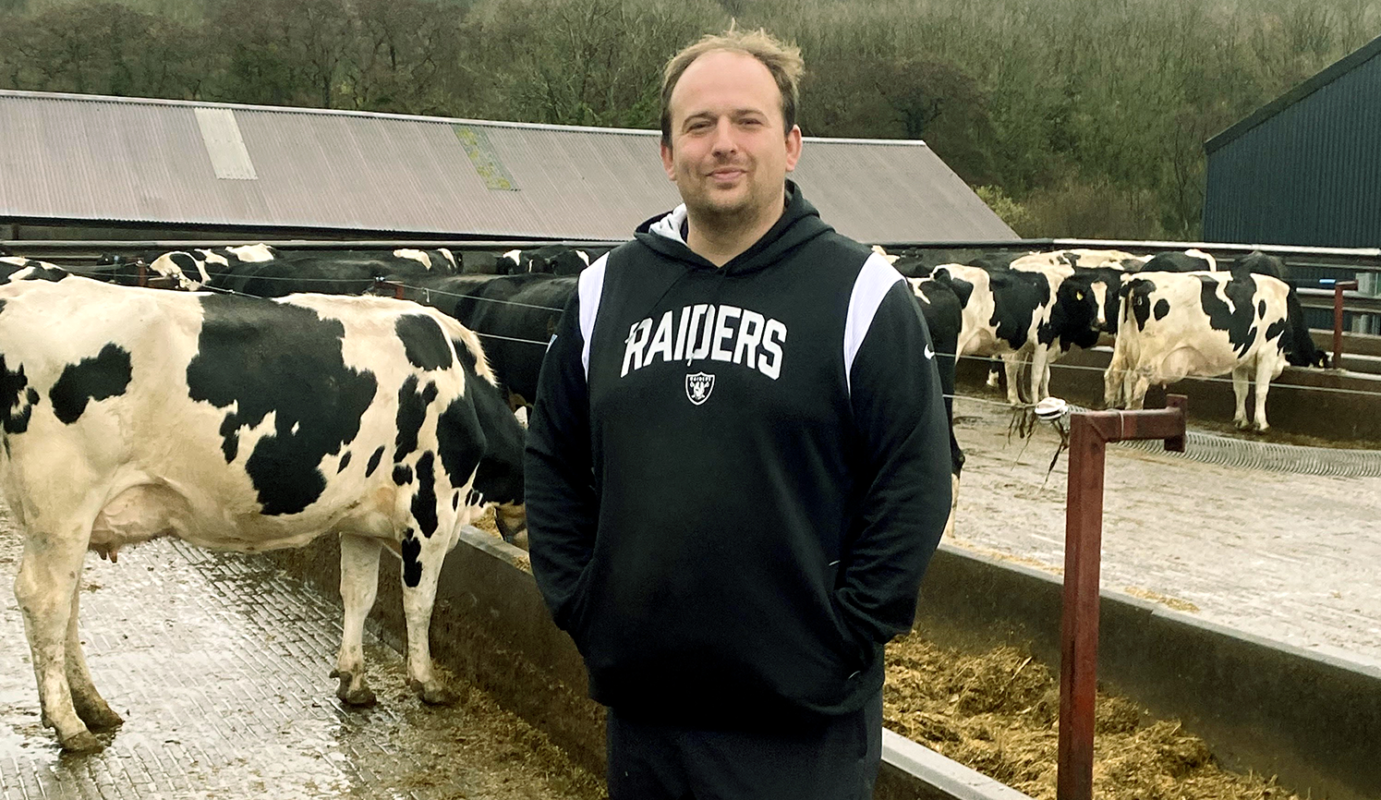
Will Holmes is striving to become an employer of choice
From multi-site dairies to new expansion in Wales, Will Holmes is building a farming business designed to endure change and to grow through it. Danusia Osiowy reports.
For Dorset farmer Will Holmes, becoming resilient is not just surviving the tough years but creating a business that thrives in them.
At just 30, Will manages a complex, multi-site dairy and arable operation in South Dorset, balancing profitability, sustainability, and people-first leadership in a way that’s quickly establishing him as one of the sector’s most forward-thinking young farmers.
Farming is in Will’s blood, but it’s innovation that drives him. After graduating from Reading University in 2017, he returned to Dorset to take on the management of a 400-cow, autumn-calving contract farming agreement with the Russell family. But the system needed rethinking, and Will set about redesigning
it for long-term efficiency.
Today, that business sits within a much broader farming structure that covers 2,500 acres across the region, all tenanted, contract-farmed or under grazing licences and includes three dairy farms and an arable unit. The dairies milk nearly 1,000 cows across 982ha, supported by 115ha of arable land producing feed wheat.
When Will’s father stepped back from day-to-day operations in 2022 to take up an Arla UK director role, Will stepped forward. “Succession has been an important process for us,” he says. “It pushed me to focus on the continued success of the business as a professional operation with systems, data and people at its core.” Across three core units, the system is delivering consistent, measurable performance. Lower Dairy runs 440 cows at peak, averaging 7,724 litres per cow and producing 3.27m litres annually; Longlands, a 315-cow herd, achieves 5,032 litres per cow for 1.46m litres a year and Littlewood, is home to 260 autumn calving cows, delivering 1.73m litres at 7,145 litres/cow. The latter two dairies are run on a day-to-day basis by contract
farmer Jon Hurford.
Together, the herds combine strong productivity with sound system design, reflecting Will’s philosophy that consistency beats extremes. His team monitors and manages the details on each of the farms and runs monthly margin-over-feed calculations, lean management spreadsheets, and compliance and cost-control trackers. “We want everyone to see how their work impacts the bottom line,” he explains. “It keeps people engaged and helps us make smarter, faster decisions.” Resilience, says Will, is built one decision at a time. The business has made significant progress in reducing inputs and boosting environmental performance. Around 72% of intensive grassland is now in herbal leys, cutting fertiliser use dramatically from more than 200kg N/ha
to under 100kg N/ha.
Manure and slurry management have also been transformed, three slurry lagoons have been built in the last four years, giving six-seven months’ storage capacity on every farm. Cattle are fenced out of watercourses, improving water quality, and nutrient recycling has become a central pillar of the system. “We’re not perfect yet,” Will admits. “But we’re proud of how far we’ve come. The goal is to farm profitably without compromising the environment we depend on.”
Perhaps the most distinctive feature of Will’s leadership is his approach to people. Across the business, Will and Jon together work with 20 staff and partners, from school leavers and college students to experienced herdsmen and line managers. Each farm now has its own management structure, giving key staff autonomy over cows, youngstock, and fieldwork. “We’re trying to become an employer of choice,” he says. “That’s not just about pay. It’s about trust, communication, and creating a workplace where people feel proud to belong.” The emphasis is on delegation, ownership and outcome-based management, supported by clear
standard operating procedures.
The result is a culture of engagement and accountability that many larger businesses would envy. “Our team buy into what we’re doing,” he says. “They care about the farms and about the job they do, and that’s a big part of why we’re successful.”
Will’s commitment to improvement extends beyond his own business. He’s an active – and current chairman – of Summit, an LIC grazing discussion group, and also takes part in the Carslaw autumn calving group. Benchmarking and open discussion with peers play a major role in driving progress. “Comparing ourselves with others helps us focus on what really matters, which is performance, efficiency and animal welfare.”
Preventative focus
Underpinning that are robust herd health and welfare metrics, achieved through a close partnership with Synergy Farm Health. Vet Josh Swain provides ongoing support on herd health and fertility, ensuring a strong preventative focus. Cow performance is monitored constantly, with low levels of lameness, mastitis, and mortality underpinning consistent output. Recent structural changes have also allowed Will to look beyond Dorset. Having relocated with his wife and young family to South East Wales, he now manages the business remotely, supported by his line managers and profit-share agreements.
Expansion is already underway, the spring-calving herd at Longlands will rise to 350 cows following some new land becoming available to the business this year. Beyond that, Will hopes to expand the business into South Wales and continue the businesses success there. “The goal now is to build growth that’s sustainable for our people, for our environment, and for our profitability. Everything we do is about creating a business that lasts.”
“I’m not sure we’re doing one thing outstandingly better than everyone else,” he says. “We are always picking up new ideas from visiting other farmers in Summit, the Carslaw Group and outside farmers we visit. We just try to do a lot of things well and put a lot of good ideas together. We’re running a resilient, growing business that tries its hardest to look after its cows, its environment, and its people, and I’m really proud of that.”