
The Middle East is becoming an important cheese export market
Everything was looking up, with dairy markets rising faster than had been expected. And then came the war. Another war. At the time of writing the omens do not look good for the long term, with the crisis escalating rather than diminishing.
In the short term, though, the crisis might give the market a boost, as buyers forget about price and concentrate on securing supplies by bringing forward future orders. In times like these it’s not ‘can I get hold of the product I need at a price point I want’, it’s ‘can I get hold of it at all’. But global demand won’t increase in the medium term, and sooner or later those order pipelines will be full, and panic buying will wane.
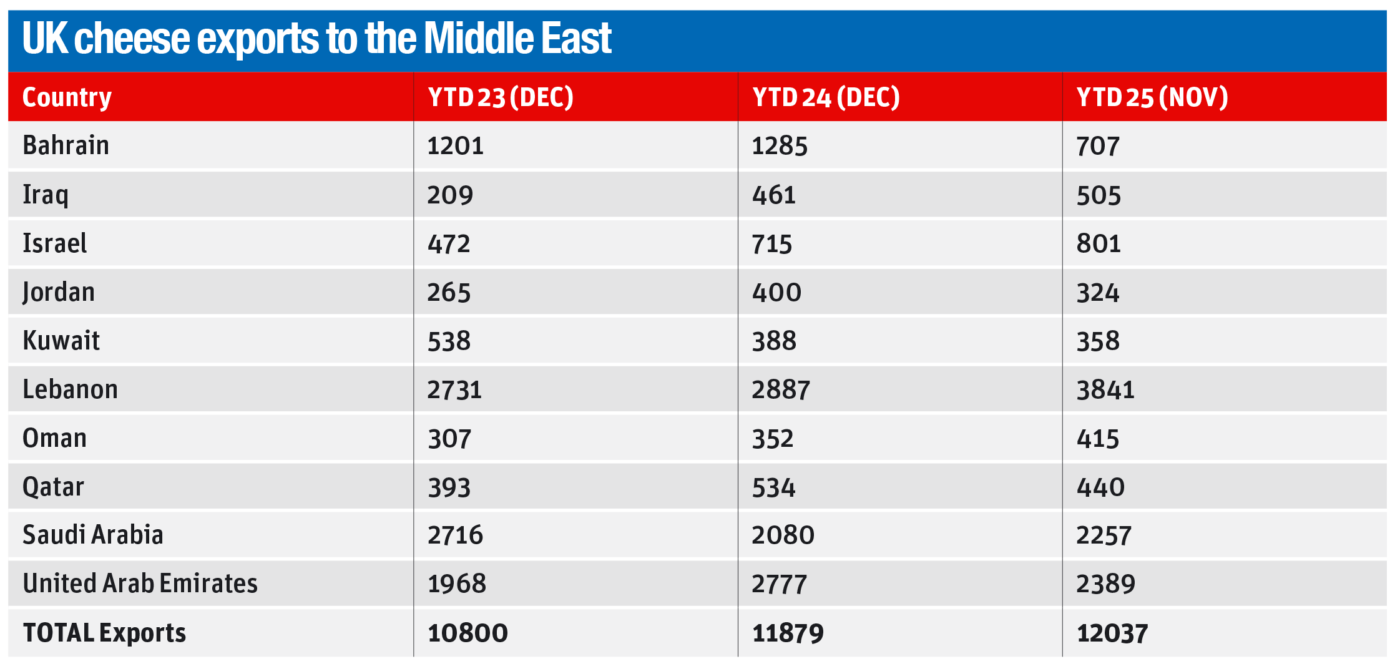
Then there are the logistics of getting product from A to B, without it going via C, D, E or F. Already ships are in the wrong place, going to different ports, or not available at all. The Strait of Hormuz is effectively closed, and this is vital for ships to access and leave Bahrain, Kuwait, Qatar, Saudi Arabia and the United Arab Emirates – and there is talk of New Zealand having to send containers back home.
Shipping costs
It is believed this issue is more problematic for the Southern Hemisphere than it is for the EU / UK, because we can use Jeddah, and then transit overland through Saudi. But it is far more expensive, and risky. Shipping costs are skyrocketing. We should not underestimate what this might mean to the UK and Europe, as exports to the affected region are significant (see table).
 The Middle East is becoming an important cheese export market
In addition, we’ve got the impact of much higher oil and gas prices to deal with. On the upside there is (usually) a link between commodity prices and oil prices, although the wheels fell off this relationship somewhat during Covid and lockdown. Thus we can expect commodity prices to rise. But they are likely to become more volatile, too. On the downside, costs increase – skimmed milk powder (SMP) processing costs are estimated to have risen by between £60 and £80/t on gas and electricity prices, depending on where you put the price.
Thus we’ve got to ride the waves and see what happens. But aside from the direct and obvious impacts there will be numerous knock-on effects. It’s very early days and currently there are too many unpredictable scenarios to make a hugely detailed analysis.
Until we can, we’ll enjoy what is currently a pretty positive ride, especially given global milk volumes. The logical law of supply and demand seems to have gone walkabout for the time being.
Certainly prices are much more positive than people thought they would be a month ago – and astonishingly so when it comes to mozzarella!
Normally, plentiful volumes would have a major negative effect on milk prices. But in New Zealand the GlobalDairyTrade (GDT) auction is not so much remarkable, it’s extraordinary. The first March auction increased by another 5.7%, which took the run of positives to five auctions in a row – its best run since early 2021. In February the auction posted its biggest increase since March 2021, the third biggest since 2020 and the 11th biggest since 2015. As a result of the good run, Fonterra has increased its milk price prediction to $9.50/kg solids (£7.11) having dropped it to $9.00/kg (£6.74) in December. And this was before
the latest auction!
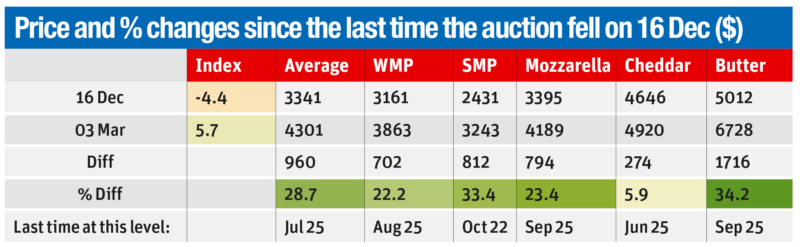
The gains have taken the prices back to thresholds we haven’t seen since the middle of last year for most commodities, and for SMP we’ve to go as far back as October 2022 to see similar prices. The last time the auction dropped was on December 16, and since then there has been a near $1,000/t (£749) and 30% increase in the value of the average basket of commodities; an $800 (£599) and 33% rise in SMP values and a $1,716/t (£1,285) and 34% rise in butter prices.
EU markets
According to my calculations, the commodities convert into a milk price of 34-35ppl, having dropped below 30p in December. The EU farmgate price is less, as commodities are trading at a significant discount to southern hemisphere ones. EU butter is at €4,900-€5,000/t (£4,242-£4,329) now, for example, compared to being below €4,000/ (£3,463) on January 20.
But Fonterra butter is €1,000 (£866) more at €5,900/t (£5,108). Arla’s SMP is at €2,600/t (£2,251), compared to being below €2,000/t (£1,732) in the last December auction. Fonterra’s SMP is at €2,800/t (£2,424). Thus the EU price only converts to a price between 30p and 32ppl.
And it currently looks as if there will be further improvement too, given market developments. At the time of writing on March 9, cream had soared to £1.55-£1.60/kg for export. If this gains another 10p or so I think some liquid processors will be pondering milk price increases, as the cream income to a processor will be around 9p, as opposed to 6-7p in January. Butter has also increased to as high as €4,800/t (£4,156) for now and €4,900 (£4,242) for the next quarter, with UK traders putting the current price around the £4,000/t threshold.
SMP is also riding higher on the back of the GDT, with Arla’s price settling at €2,600/t (£2,251) and Solarec’s €100 (£87) higher. But traders put the current market at €2,550-€2,600, with UK prices at £2,200 to £2,250/t.
EU exports are continuing to do well, and will be further helped by the Euro-Dollar exchange rate. The rising prospects point to Skelmersdale farmers receiving a price above 30p for the first time since last November, by my calculations.
The prospects are currently looking up for cheddar makers, too. Firstly, whey is at €1,400/t (£1,212), and it hasn’t been at this level since April 2022. And cheddar prices have also increased on the back of a complete lack of availability, lower stocks than last year, and buyers all stepping in to the market to try and secure what limited supplies might be out there. But manufacturers say they are sold up, and seem very relaxed indeed. Mild is at least £3,100/t if not £3,200, but buyers aren’t ready to pay these prices yet, some say. Mature and coloured are both said to be extremely tight, with prices increasing here too.
Star of the show
But it’s mozzarella that is the current star of the cheese show, as availability of that is very scarce on the back of very good demand. It also had a near 8% boost on the GDT, with Arla’s jumping to €3,575/t or £3,100. Traders say the UK price has increased £250 since the last report to £3,200-£3,250/t – its highest level since last September. On the back of this I think I can confidently say that there will be price increases announced for May by the mozzarella makers.
They won’t want to do it, as it will send all the wrong signals to farmers, in that they will think the worst is over and they can continue to produce oceans of milk. But if current prices stick it would be unfair if they didn’t pass some of that back.
Whether these prices do stick cannot be taken for granted, though. Anything can happen with a war, and one major thing hasn’t changed and that’s supply. The fundamentals on supply haven’t changed at all. It begs the question as to how long the market can buck itself by ignoring the fundamentals – war or no war. And no one, so far, has the answer to that.