
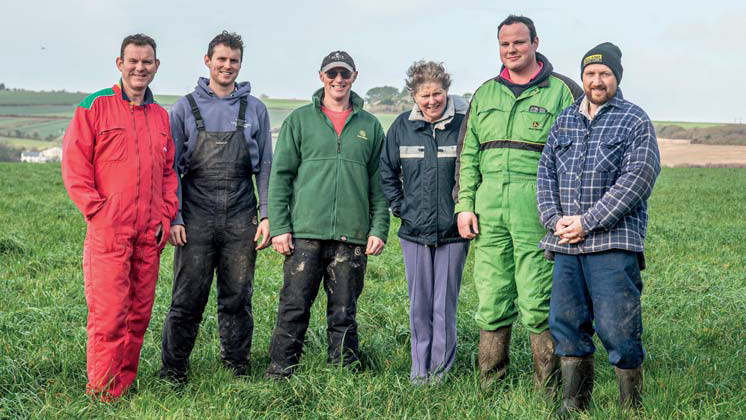
The 2025 RABDF/NMR Gold Cup was presented to Paul Broad of T N Morrow and Partners. Ruth Wills visits their standout herd at Treveale Farm near Ladock, Cornwall.
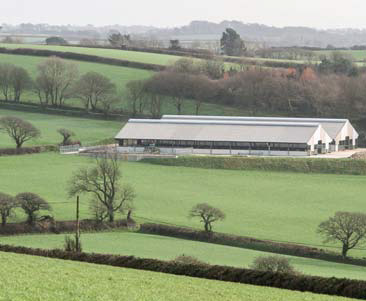
When driving into Treveale Farm, the two words that come to mind are immaculate and impressive. It’s clear from the outset that attention to detail and thoughtful design are two priorities for the family. And a family business it truly is, with Paul Broad and his wife, Wendy (née Morrow), together with Wendy’s brother, Irwin Morrow, and Paul and Wendy’s sons, David and Philip all playing their part in the system. “Wendy and I do most of the milking, Irwin and Philip do the tractor driving, and David does the youngstock,” says Paul.
The Morrow family originated from Northern Ireland, and settled at the then 52-ha Treveale Farm in 1979. Originally opting for British Friesians, they eventually swapped to Holstein Friesians and haven’t looked back, becoming pedigree in 1985.
“In 1992, I married Wendy, and my father-in-law, Neville, bought the farm next door, which was another 80ha – that was a fair gamble at the time,” explains Paul. “So we went from 70 cows up to 280 and gradually acquired more ground over the years to take us up to 202ha.”
David and Philip both developed a passion for farming, which spurred on another significant change to the system. “In 2011, we realised that both boys wanted to go farming, so we set our sights on building a new unit,” says Paul.
The greenfield site was selected just down the road from the original farm. “It took us until 2014 to get planning permission, then we started building in 2016. We started with one silage pit, then a shed, then in 2018 we built the dairy – when the milk price was down at 16.7ppl,” he says.
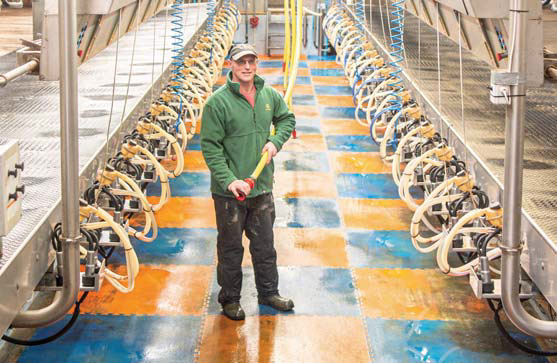
And the herd has expanded too. “We have gone from 280 cows up to 470, just gradually building over the years, keeping our own heifers – except a couple bought in from the Willsbro herd.”
They went from milking in a 24/24 herringbone parlour to a 40/40 rapid exit. “With a herringbone, the cows are at a 35° angle, and now they’re at a 90° angle, so they had to take a step around, which opens up the divider for the next cow,” explains Paul. “It took some time for them to get used to it, particularly because we don’t feed in the parlour.”
A HerdVision camera is installed to track body condition score and lameness. “It’s an aid, and it does help with the body condition scoring. We also have a foot trimmer every three weeks.”
Housing
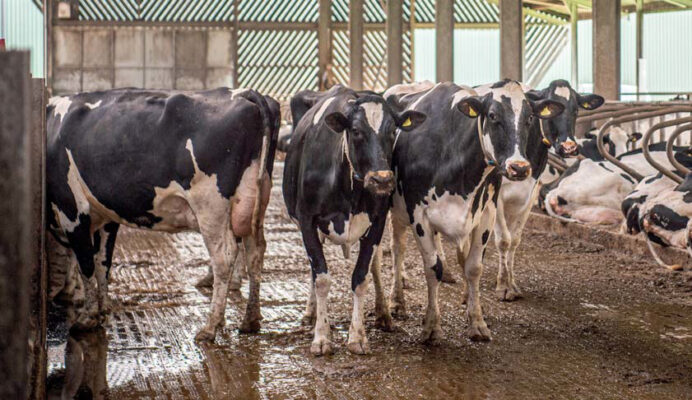
When it came to the housing, a lot of attention was paid to the design. “We designed it all ourselves; we didn’t bring in a consultant – we toured different farms and decided what we wanted,” says Paul.
“We have long, wide centre feed passageways with self-locking yokes – they have been a game changer. They were the first thing we put in the shed, and I wouldn’t be without them – we have one for nearly every animal now. There is no stress on the animal, for vet visits, vaccinations, tail clipping – it’s easy, for the people and the cows.”
And the centre passageways are designed to protect the good quality forage. “The centre feed passageways add 20ft onto the shed, but we don’t spend all this time and money getting the feed right for it to be fed on the outside of the house,” he adds. “Whichever way you feed it, one side, one day will get rain on it – we’re making the most of our forage.
One thing we have learnt is that the cow doesn’t know what the milk price is; we still have to feed her to realise her full potential, whether it’s 50ppl or 32ppl.”
That said, the family are strict on culling. “We only have so many spaces for cows, so if we have one in there that has the potential to give 45 litres, and another one giving 28 litres, and we’re feeding for 37 litres, we’re losing eight litres on that cow. We might as well have something that will give us 40 litres.”
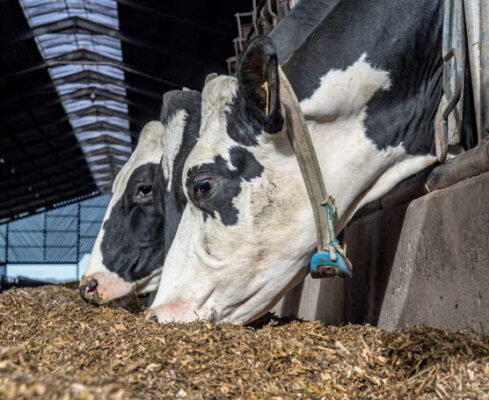
The family opted for resin on the feed passageways. “I always say, we don’t eat our breakfast, dinner and tea off the same plate, but they are, so you must keep it clean. If we had just put concrete down, after seven years the acid load would have made holes in it, but the resin is like new,” Paul says.
Not only are the shed roofs designed to collect rainwater, which is then used to wash down the parlour, but they offer good ventilation too. “We have a 17° pitch in the roof; most sheds are 12.5°, so we have better ventilation – we don’t have any fans in the sheds. We don’t have any skylights either, because in the summer it’s like a magnifying glass, but we do have a ridge up the centre of the feed passageway, so that brings light in.
“We also have LED lighting, which comes on at 5am and goes off at 9pm, so it gives 16 hours a day of light. It replicates spring daylight, which is when the cows give the most milk, so in the autumn it’s worth at least one kilo a day of milk.”
The cows are bedded on deep sand. “The sand is brilliant for comfort as well as mastitis levels – we’re milking 12,100kg twice a day across the herd, so the cows are carrying a lot of milk. We bed them up twice a week and rake the beds every night.”
Due to the sand bedding, the slurry must be separated. “We’re in a nitrate vulnerable zone (NVZ) so we have had to spend more on slurry storage, but the separator allows us 20% more capacity, so we have storage for 2.7m gallons,” he explains. “We take the solids away and spread them on the maize ground, and then the liquid is spread after each cut of silage. It’s a valuable fertiliser, it has 10 units of nitrogen in every 1,000 gallons, so we put on 28,061 litres/ha (3,000 gallons/ac) after every cut.”
The family have complete control over each element of the system, particularly feed. “The biggest thing we have learnt from the new unit is control; we have big silage pits and take seven cuts of silage a year. We layer the pit, so we feed it out the same way it goes in,” notes Paul. “It’s about having the continuity, which is all Holsteins want.”
The farm grows 107ha of maize, 64ha of winter wheat, and the rest is Italian ryegrass leys, which are cut roughly every 21 days, starting in mid-April, with 18ha allocated to grazing in-calf heifers. A cover crop of ryegrass is grown on the maize ground, while a cover crop of ryegrass and vetch is grown on the wheat ground.
“We have been growing cover crops since before it was trendy,” laughs Paul. “We had these maize stubbles, and the soil was being washed away. But with cover crops, not only do you stop that, but you get a double crop, which is important on limited acreage.”
The cows are fed a full total mixed ration (TMR). “They’re on roughly 14.5kg/head of concentrates, which contains an oilseed rape blend, homegrown urea-treated wheat, Megalac and ground maize,” he says. “We always try to have a six-month buffer of feed, so we don’t run out if we get a dry year.”
High-quality forage
The family aim to produce top-quality forage. “The cheapest thing we can produce is grass and maize – so we make it as good as possible. We reckon we only need 12 to 14 dry days a year (for silage making), because we’re not grazing it at the same time – we don’t waste any grass,” says Paul.
Most operations are undertaken in-house, except picking up the grass with a forager, for which they use a local contractor – Roy Davey. “We cut it, ted it and rake it ourselves; for us it warrants having the control over when we cut it.”
The milk is sold on a contract to Arla. “We’ve always stuck with the co-ops, and I think our loyalty has paid off. Everyone waits to see what Arla’s price is and prices accordingly. The main thing is we have always had an evergreen contract – so they pick up however much milk we produce. And with us wanting to expand over the years, it would have been foolish to give that up.”
Youngstock
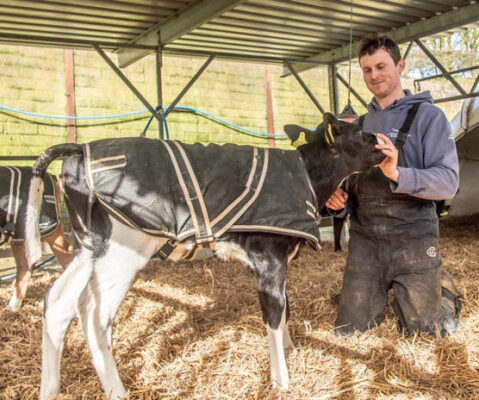
David takes charge of the youngstock side of the business. “We’re aiming to produce 200 heifers a year, so we use sexed semen on the best 50% of the cows twice, followed by beef, then 70% of the heifers get two goes of sexed semen, then they’ll go to beef,” explains Paul.
If the farm is clear of TB, then all beef will be sold. “They’re sold either as calves or stirks; some go to Holsworthy market, or to our neighbour to rear,” he says.
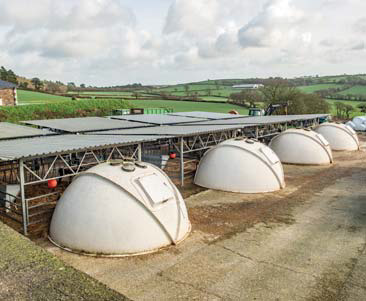
They use calf igloos to house the calves. “We have had igloos for 10 years; they’re brilliant for calf health. We put a group of 14 in there; it’s safe, clean and disinfected before he next batch. They get four litres of colostrum, then milk from the second and third milkings for three days. After that, it’s all pasteurised milk, which we find they grow well on. It’s always fed at 42oC and they are weaned at eight weeks before going onto a concentrate diet.”
The replacement rate runs at between 25% and 30%. “We’re picky about getting the right type of cow; we want to continue improving the overall quality of the herd,” notes Paul. “We look for good feet and legs, a good udder to hold the milk, and the capacity to eat plenty of forage.”
The age at first calving is roughly 23 months, and the heifers are kept in a separate group to reduce bullying when they enter the herd. “The heifers stay together for their first lactation; they’re in with their peers rather than in with the big cows getting pushed around,” he says.
The herd is Johne’s disease and bovine viral diarrhoea (BVD) free. “We have worked on eliminating the risks of Johne’s disease and BVD over the years,” he says. “We began by testing and then gradually weeded it out. Pasteurising the milk has also helped reduce the risk to the calves.”
Next generation
It’s clear that efficiency, alongside cow health and welfare, is key for the family. “By building this modern dairy unit, it has increased our ability to produce milk more efficiently, as well as look after the cows to a higher standard. You look after the cow and the cow will look after you,” he says.
And the family have invested with the future generation in mind. “In the past eight years, we have reinvested in the future,” notes Paul. “We’re putting our money where our mouths are for the next generation; they have the enthusiasm, and you’ve got to have youth in farming.”