
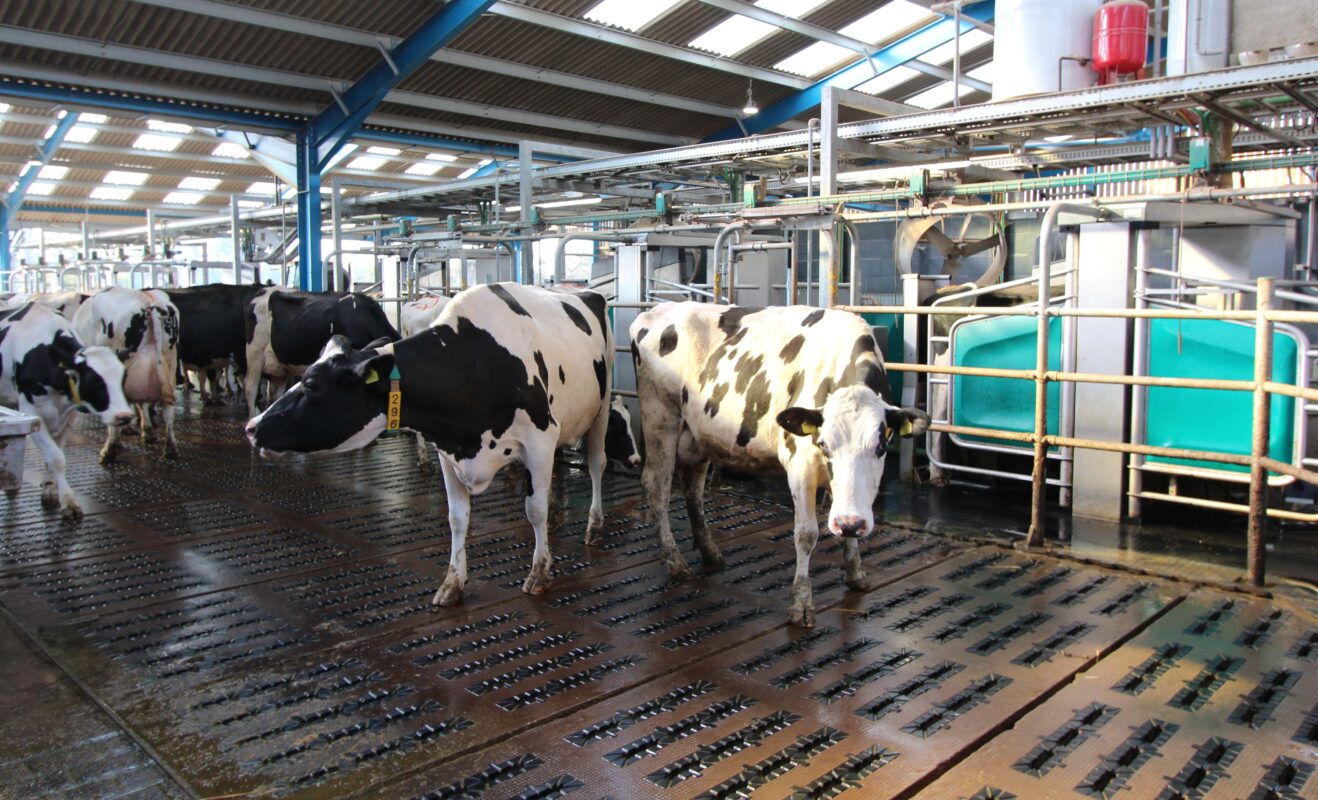
Andrew was tied to milking his 500-cow herd three times a day, so felt the robots were a natural progression
It can take some time to fine-tune the process of moving to robotic milking, something which one Chester dairy farmer executed with his pedigree Holstein herd since replacing his ageing rotary milking parlour. So how has he achieved it?
Gareth Jones reports.
In March 2024, Andrew Walley of Cotton Abbots Farm, just outside Chester, bought in ten GEA R9500 robots to replace his ageing rotary milking parlour. Already tied to milking the 500-cow herd three times a day, he felt the robots were a natural progression.
Throughout the process, he involved his Herd Manager, Warren Thomasson, with the decision making, as he would be the one running the unit. “We considered various [robot] brands,” explains Warren.
“We didn’t want a bath positioned on the exit of every robot.”
“But in the end, it came down to the R9500’s smaller footprint, its ability to separate milk per quarter, as well as the in-liner pre- and post-milk preparation, which swung it in GEA’s direction.”
They decided to form one group of 150 heifers on three robots, with the main herd of 300 cows on six machines, and an additional freshly calved group of up to 45 cows, all operating on free access to the robots,
with a guided exit.
“We knew that we wanted to incorporate footbathing,” explains Warren. “But we didn’t want a bath positioned on the exit of every robot, or it would add a significant cost to the project. It can also cause a bottleneck when cows are leaving the robots. So when we saw the guided exit, which allowed the footbaths to be positioned well away from the robots, it seemed like a good solution.”
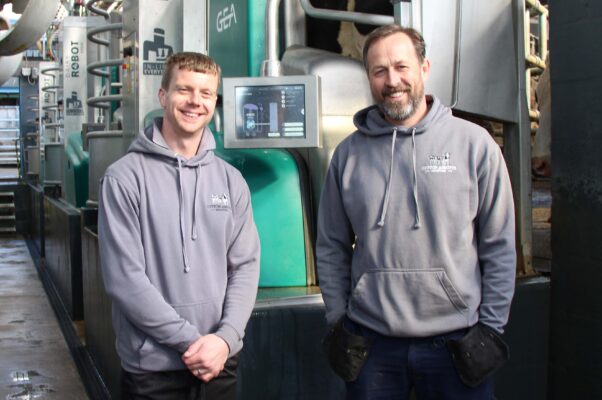 Herd manager, Warren Thomasson, was involved in the decision making
Small details
Every small detail was considered to train the animals to the system, so the heifer group enters the robots from the right-hand side, and the fresh group from the left. This means that by the time they arrive in the main herd, no animals have a preference for right or left-handed machines.
The team also liked the idea of having a pit so they could treat any cows in the box, or manually attach clusters if necessary – so this was incorporated into the design of the system.
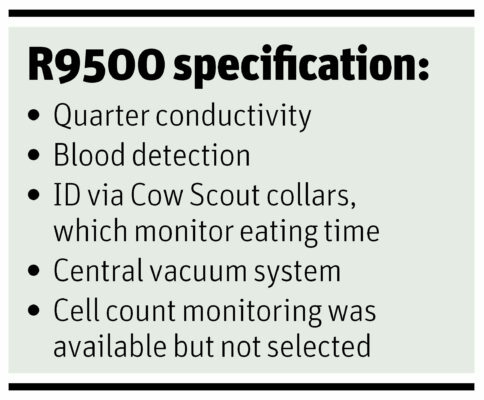
“We decided not to go for the cell count monitoring,” explains Warren. “Because we have the quarter conductivity, if we see a spike in any quarter, we just separate the milk and test it ourselves.”
The fresh calvers and main herd are fed for maintenance plus 37 litres outside on a ration of maize, grass silage and blend, before being fed to yield in the robots, up to a maximum of 12kg of concentrates. A dose of liquid feed is also given in the robot to the fresh group to help bridge the energy gap at this stage of their lactation.
A fine balance
The main herd is averaging 2.9 visits/day with an average yield of 47kg/cow per day and a milk speed of 3.1kg/minute.
There is 20% free time (time when the cows aren’t being milked) on the robots, which means the system isn’t under stress. “It’s a fine balance between milking cows too often, which can use up valuable box time, and getting the most out of the cows,” says Warren. “The average yield per visit is 15.7kg, which seems to be the optimum for us.”
The heifers are averaging 35 litres each with the same level of visits, but as they are calving at around 22 months, Warren is keen to ensure they are well looked after in their first lactation. “They are still growing, and we don’t want to work them too hard,” he explains. “So, some of them do two lactations in this group before joining the main herd.” www.roboticmilkingsystems.com
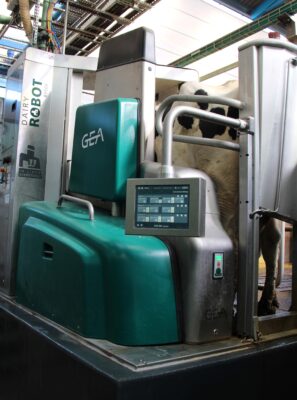 GEA’s R9500’s robot was chosen