
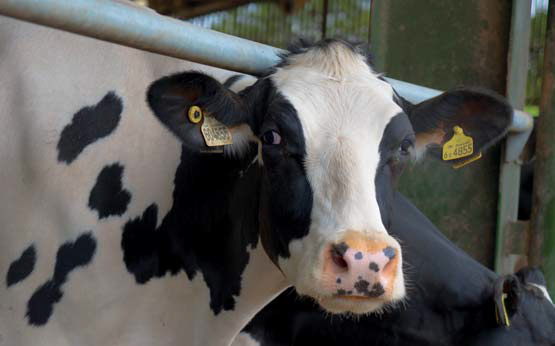
It’s been a busy time for the Harper Adams dairy team, opening their gates for Open Farm Sunday and the RABDF / NMR Gold Cup Open Day while still keeping the farm running. Two of the dairy managers, Alice and Becky, share how it’s all been going.
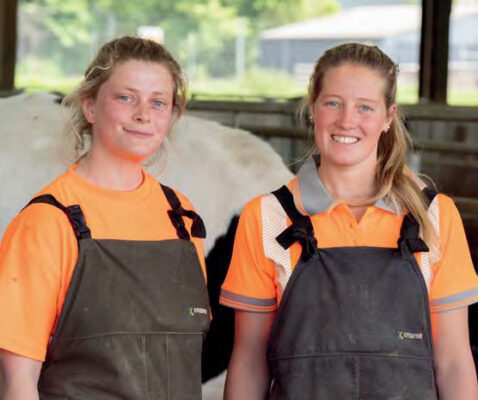
It’s our turn to take the helm, so we’d like to introduce ourselves. We’re Alice and Becky, both Harper Adams graduates in BSc Agriculture (class of 2020 and 2018, respectively). We’ve been part of the Harper Adams Farm team for around five years in various roles and are currently the deputy dairy section managers within the Future Farm team, overseeing herd management.
We’re often mistaken for students – which always makes us laugh -but people are usually pleasantly surprised when they find out we actually work here. Unlike the typical image of a family-run farm, most staff at Harper Adams are female. Over time, this has helped create a more welcoming environment for women entering agriculture. We’re immensely proud to play a part in giving aspiring farmers and students that boost of confidence and a relatable role model they might need.
We’re writing this off the back of a fantastic Open Farm Sunday, where we welcomed over 1,000 members of the public. The weather played its part – with only a couple of light showers and plenty of sunshine, the farm looked its best.
Milking is always a crowd-pleaser, and the viewing gallery was packed. Visitors also explored our machinery, met the beef cattle, sheep, and pigs and learned about our environmental projects. Erin led some great talks about our calves, and guests had fun suggesting names for two of them. The surprise star of the day? A cow calving in front of a captivated audience – an unforgettable moment for many.
Events like these are exactly why we open our gates – to give people unforgettable experiences and insights into the realities of farming. On our side, we kept the cows moving smoothly despite the crowds, which is a credit to our calm and docile herd. Even with all the excitement, they took it in their stride, stopping now and then to greet the visitors.
We were also pleased to host the Staffordshire Women in Dairy group last month, and we welcomed guests to the Stride event on June 20, which looked at cow foot health through demos and talks.
Behind the scenes, we’ve also been focusing on dry cow management, after identifying a group of ketotic cows at their ‘Fresh Check.’ At that stage, the damage is already done, so we’ve created an action plan to both support high-risk cows and prevent further cases.
Dry cow care
Working closely with our vet Dan and nutritionist David, we mapped out every aspect of dry cow care. After some in-depth discussions, we’ve decided to adopt two separate diets: One for the far-off group and one for the close-to-calving cows, three weeks pre-calving. This approach will help us maintain better body condition scores and meet the transition cows’ nutritional demands – especially important as dry matter intake typically drops before calving. We’ve found the old ‘one diet fits all’ method difficult to balance properly.
This decision was made easier thanks to AlgoMilk, which Kate mentioned in her previous article. We’ve now fed more data into the system from our herd management software and milk recordings, and it’s begun providing tailored suggestions. These include feeding adjustments, group movements, and forage calculations, while always considering what’s practically feasible on our farm.
Useful recommendations Some of the most useful recommendations involve dry-off timing, group transfers, and ‘do not breed’ flags. If a cow would have a better income over feed cost in a different group, the system suggests the move while factoring in feed availability, stocking density and cubicle space.
Looking ahead, we’re about to start a new feeding trial. Up to 48 cows will participate, varying in days-in-milk, status, lactation number and other criteria. Historically, students collect weekly milk samples for their honours research projects and researchers will regularly weigh and blood-sample the cows.
In past trials, we’ve faced challenges around fertility and ensuring adequate feed and rest time, especially since moving to three-times-a-day milking. This time, we’ll be carefully monitoring welfare and productivity to keep trial cows within commercial key performance indicator ranges. We work closely with Professor Liam Sinclair and his team of researchers, who monitor individual cow feed intakes via the Hokofarm RIC feed bins.
Biggest supporters
By the time this reaches you, we will have hosted the RABDF-NMR Gold Cup Open Day (see the report on p40). Over 50 trade stands were booked, with talks being given from some of our biggest supporters: Our vet Dan Humphries, nutritionist David Howard, and foot trimmer Jon Offland. Their support and advice over the years has been invaluable. They’ve been with us for the majority of our careers here and have helped us through many challenges, always with good humour and sound guidance. We’re incredibly grateful to them.