
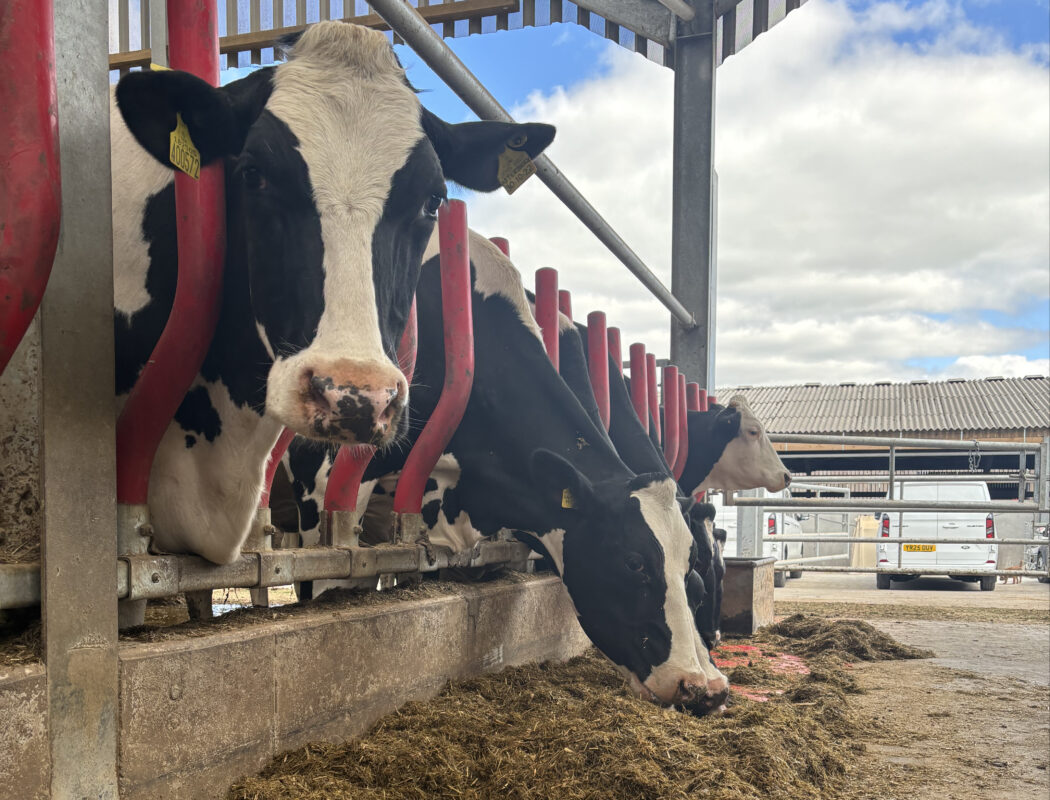
The smart bolus can send alerts about health, calving or feeding behaviour
Bolus sensors deliver data straight from inside the cow to a smartphone or computer. And by combining smart tech with sharp stockmanship, one farm is boosting yields, cutting medicine use, and catching problems before they start.
Danusia Osiowy reports.
Farming has always been about timing – knowing when to calve, when to treat, when to act. But what if you could predict these moments hours or even days in advance, guided not by instinct but by real-time insight from inside the cow?
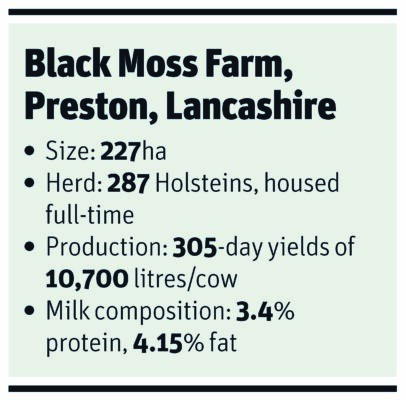
At Black Moss Farm, in Preston, Lancashire, that’s now the everyday reality. Using Smaxtec bolus technology, Farm Manager Ed Swindlehurst and Herd Manager Jamie Waller have transformed the way they approach herd health, calving and treatment protocols. They are combining early detection with targeted action, and all without adding to their labour burden.
“We weren’t catching things early enough.”
When Ed took over the farm in May 2023, he faced a long to-do list to optimise performance in the key areas of fertility, mobility and longevity, which all needed urgent attention. From the outset, he had a clear ambition to achieve better performance, fewer problems, and a more efficient way of working.
“The herd wasn’t in the worst place, but it needed tightening up,” he explains. “We had issues with fertility, lameness and cow condition. It wasn’t one big thing, but lots of little things that all needed addressing.”
With Jamie’s help, the pair focused on improving genetics, refreshing the system, and refining herd routines. But it was the introduction of new technology in December 2024 which gave them the edge, delivering real-time data that allowed them to predict issues before they became visible.
Faster and smarter
“We realised that even though we were good at spotting problems early, we weren’t catching things early enough,” says Ed. “When we had a bout of E. coli, it pushed us to look at tech that could help us act faster and smarter.” The internal bolus, administered once orally in the cow’s life, sits in the reticulum. From here, a small sensor collects a suite of data every few minutes, including core body temperature, rumination (via reticulum contractions), drinking frequency and volume, movement, and (optionally) pH – all from inside the cow.
In addition, a climate sensor mounted in the barn records ambient temperature, humidity and air pressure, helping farmers factor in external stressors like heat or storm conditions.
This information is transmitted wirelessly via a base station to the Smaxtec’s TruD platform, where it is analysed using artificial intelligence and proven algorithms. The results offer clear, prioritised alerts and graphs, sent directly to the user’s phone or PC. “You choose which alerts you want, whether that be health, calving or feeding behaviour, and you can access it all in a structured way,” explains Jamie. “It’s not just data, it’s actionable information that helps you make better decisions.”
One of the biggest breakthroughs at Black Moss Farm has been in calving management. The technology detects a cow’s pre-calving temperature drop, which typically occurs 10-15 hours before calving. This triggers an alert which allows the team to prepare in advance – and a second alert flags if the temperature drops too far, potentially indicating subclinical milk fever.
“That’s when we step in,” says Ed. “We’ll check her and give calcium if needed. I’d say we’ve got fewer problem cases now, because we’re catching them earlier. Clinical milk fever is rare.”
Visual confirmation
Using calving progression graphs, Jamie and Ed can assess whether labour is progressing normally or whether intervention is required. “It usually gives you a 16-hour window,” Jamie adds. “And we use our barn cameras alongside the app alerts, so I’ll check a cow’s stats, then confirm with a quick visual.”
It’s still early days, but just four months after installing the system, the results are already speaking for themselves. Herd size has edged up from 278 to 288, and yields are following suit. The average 305-day milk yield has climbed from 10,700 litres/cow to 10,988 litres, a boost that Ed and Jamie attribute not just to feeding or breeding, but to earlier interventions and smoother calvings thanks to better data. Meanwhile, herd health and efficiency have taken a clear turn for the better. The number of cows culled has nearly halved, dropping from 35 to 20 in the same time period, while only one death was recorded both before and after the system’s installation.
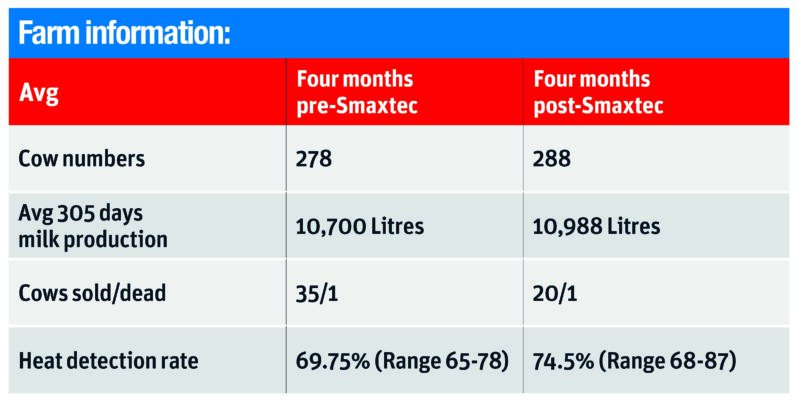 Comparison of four months pre-Smaxtec and four months post-Smaxtec
Perhaps most notably, average heat detection rates have jumped significantly – from 69.75% to 74.5%, enabling more accurate insemination timing and reducing the risk of missed heats.
For Ed, the gains are about more than just the numbers. “It’s the confidence it gives us,” he says. “We can make better decisions, faster, and we’re not always chasing problems after the fact. That changes everything.” There has also been dramatic drop in medicine use across the herd – and this is a reflection of how early detection is reshaping the way the team approaches herd health.
In just four months, the farm has cut its use of injectable antibiotics by more than half, falling from 3,484ml to just 1,669ml across the whole herd. The number of antibiotic tubes has dropped even further, down 62% from 53 to 20. Within the same time period use of non-steroidal anti-inflammatory drugs has halved, and reliance on mineral boluses has followed the same trajectory. Even calcium-magnesium supplements have seen a reduction as only short courses of support are needed. According to Ed, this isn’t about cutting corners, it’s about treating smarter. “We’re not medicating cows just in case,” he explains.
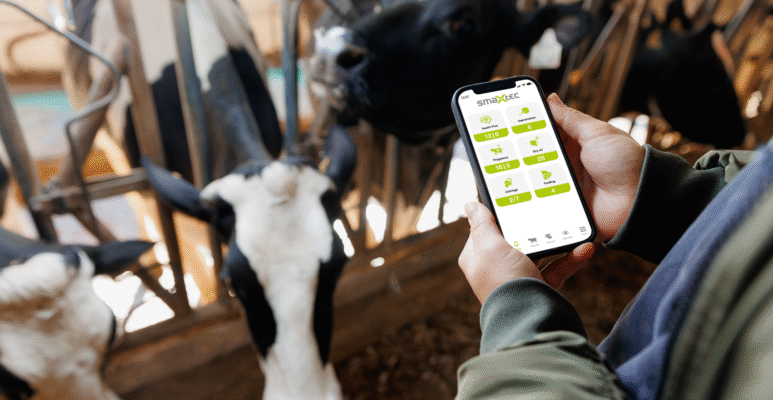 Information can be accessed through a phone app or a desktop computer
Proactive care
“We’re medicating when we know it’s needed. That saves us money, improves welfare, and fits with the industry’s push to reduce antibiotic use.”
With the system alerting them to subtle changes in temperature, rumination and behaviour – often well before visual signs appear – Ed believes the interventions are not only more effective, they’re also more targeted. It’s proactive care rather than reactive firefighting, and the herd is healthier for it, he says.
At a time when labour is short across the industry, the technology has also helped the team work smarter, not harder. “This system doesn’t replace stockmanship, it enhances it,” says Ed. “We still walk the cows, but now we walk in knowing exactly who to check. That’s a game changer.”
Both Ed and Jamie highlight how the structured dashboard and AI-backed analysis help them triage their day more effectively, allowing better time management, clearer decisions, and more confident delegation.
With the first homebred heifers set to calve down this winter, Ed is confident that Black Moss Farm is well positioned for the future.
The youngstock shed is built and further breeding plans are in motion. And the focus remains on consistency, not chasing headline yields.
“Our priorities are welfare, longevity, and doing things properly,” says Ed. “We’re future-proofing the farm without throwing labour or guesswork at it. It’s just a better way of working.”